Introduction
Context Engineering for Coding Agents is the practice of carefully selecting and structuring the information that large language models receive so they can write better code. Unlike simple prompts, this approach focuses on delivering the right files, rules, history, and tools at the right moment.
For developers in the United States and Europe, mastering Context Engineering for Coding Agents has become essential. LLM agents now handle more of the software engineering workflow. When context is poorly managed, agents produce irrelevant or incorrect results. When context is engineered well, they understand repositories, follow project standards, and complete complex tasks more reliably.
This guide explains what Context Engineering for Coding Agents means, why it outperforms longer prompts alone, and how to apply practical strategies that improve real coding outcomes.
What Is Context Engineering for Coding Agents?
Context Engineering for Coding Agents means designing the full set of tokens an LLM agent sees during inference. This includes system instructions, relevant code files, documentation, conversation history, tool outputs, and retrieved knowledge.
What Context Means for an AI Coding Agent
Context is everything the model can attend to when generating a response. For coding agents this typically covers repository structure, selected source files, project conventions, test results, and recent session history. The goal is high-signal information rather than maximum volume.
Why Context Matters More Than Longer Prompts
Longer prompts often dilute attention. Models suffer from context rot as the window fills with low-value tokens. Effective Context Engineering for Coding Agents prioritizes relevance and timing so the agent focuses on what actually matters for the current task.
Why Context Engineering Matters for AI Coding Agents
Strong context management directly improves the quality of AI-assisted software engineering. Agents that receive well-curated information understand codebases more accurately and produce fewer off-target suggestions.
Better Codebase Understanding
When agents receive repository-level context such as directory structure, key modules, and architectural notes, they can navigate and modify code with greater precision. This reduces the need for repeated clarification.
Fewer Irrelevant Outputs
Poor context leads to hallucinated APIs or style violations. Context Engineering for Coding Agents filters noise so responses stay aligned with project reality.
More Reliable Software Engineering Workflows
Reliable agents support longer tasks such as multi-file refactors or test generation. Developers spend less time correcting basic mistakes and more time reviewing meaningful changes. Related discussion appears in Why Developers Spend Less Time Coding
The Difference Between Context Engineering and Prompt Engineering
Many teams still treat prompt engineering as the primary skill. Context Engineering for Coding Agents expands the scope beyond wording.
What Is Prompt Engineering?
Prompt engineering focuses on crafting clear instructions, examples, and output formats. It remains valuable for one-shot tasks and role definition. A solid overview is available in Mastering Prompt Engineering
Context Engineering vs Prompt Engineering
Prompt engineering shapes the request. Context engineering decides which supporting material enters the limited context window across an entire agent run. The latter includes retrieval, memory, tool results, and session state.
Why Coding Agents Need Both
LLM agents operate in loops. They generate code, call tools, read files, and iterate. Both precise prompts and carefully managed context are required for consistent software engineering results.
What Information Should Coding Agents Receive?
Successful Context Engineering for Coding Agents starts with knowing which categories of information deliver the highest value.
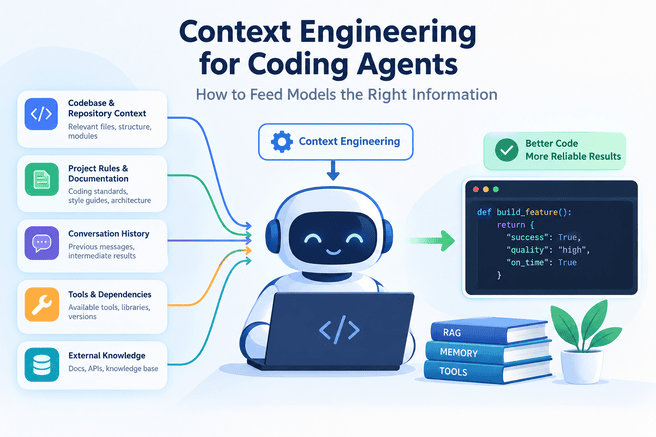
Codebase and Repository Context
Agents need access to relevant source files, type definitions, and architectural patterns. Dumping an entire monorepo is rarely effective. Selective retrieval of the modules under change works better.
Project Rules and Documentation
Coding standards, style guides, testing conventions, and architectural decision records help agents stay consistent with team practice.
Conversation and Session Context
Recent dialogue, previous tool outputs, and intermediate results keep the agent oriented across multiple turns.
Tools, Dependencies, and External Information
Tool definitions, package versions, and just-in-time external documentation complete the picture. Overloading the window with every possible tool reduces focus.
Context Engineering for Coding Agents: Sessions, Skills, and Memory
Long-running coding work depends on how sessions, skills, and memory are handled.
Session Context
Each session should start with the minimum high-signal material required for the current goal. Compaction techniques remove completed steps so the window stays usable.
AI Agent Memory
Persistent memory stores preferences, past decisions, and project facts across sessions. Short-term memory covers the active conversation. Both need deliberate design.
Context Engineering Skills
Developers must learn to select, compress, order, and isolate information. These skills become as important as writing good prompts.
Managing Long-Running Coding Tasks
For multi-hour or multi-day work, agents benefit from checkpoints, summaries of progress, and selective reloading of key files. This keeps Context Engineering for Coding Agents effective over time. Building basic agents is covered in Building Your First AI Agent
How Retrieval-Augmented Generation Improves Coding Context
Retrieval-augmented generation (RAG) is a core technique inside modern Context Engineering for Coding Agents.
What Is Retrieval-Augmented Generation?
RAG retrieves relevant documents or code snippets at query time and adds them to the prompt. This grounds the model in current, project-specific data instead of relying solely on training knowledge.
RAG for Codebases
Code-aware RAG indexes functions, classes, and documentation. When an agent needs a particular module, only the matching pieces enter the context window.
Just-in-Time Context Retrieval
Rather than pre-loading large amounts of material, agents retrieve information only when needed. This approach reduces noise and token cost while improving relevance.
7 Practical Context Engineering Strategies for Coding Agents
These seven practices form a practical checklist for improving results with LLM agents.
1. Start With High-Signal Context
Begin every task with the smallest set of files, rules, and examples that fully specify the goal. Avoid filling the window out of habit.
2. Give Agents Repository-Level Information
Provide structure, key entry points, and architectural notes so agents understand how pieces fit together.
3. Separate Instructions From Reference Material
Keep behavioral rules short and distinct from large reference files. Clear separation improves attention.
4. Retrieve Information When Needed
Use search and RAG so agents pull only the current relevant slice of the codebase.
5. Manage Context Across Sessions
Summarize completed work and carry forward only essential state. Persistent memory helps maintain continuity.
6. Keep Tools and Outputs Focused
Limit the tool surface and prune intermediate results that no longer matter.
7. Test and Improve Context Continuously
Measure success rates, token usage, and correction effort. Iterate on what enters the window. Authoritative guidance appears in Anthropic’s Effective Context Engineering for AI Agents
Context Engineering for Multi-Agent Systems
When several agents collaborate, Context Engineering for Coding Agents becomes more complex and more important.
Giving Each Agent the Right Context
Assign specialized context to each role—one agent receives architecture rules, another receives test suites, a third receives deployment constraints.
Sharing Context Between Multiple Agents
Shared memory or carefully designed message formats allow agents to exchange only necessary information without flooding every participant.
Avoiding Context Overload in Multi-Agent Systems
Isolation and selective sharing prevent the common failure of every agent seeing every token. Practical multi-agent patterns are discussed in Essential Multi-Agent Systems
FAQs
What Is Context Engineering in AI?
Context engineering is the practice of curating the optimal set of tokens—instructions, retrieved data, memory, and tool results—that an LLM sees during inference so it produces the desired behavior.
How Is Context Engineering Different From Prompt Engineering?
Prompt engineering focuses on the wording of instructions. Context engineering covers the full configuration of information inside the limited context window across an agent’s entire run.
Why Is Context Engineering Important for Coding Agents?
Coding agents work across large repositories and multi-step tasks. Without deliberate context management, they lose focus, hallucinate, or produce code that ignores project conventions.
Can RAG Improve Coding Agent Performance?
Yes. Retrieval-augmented generation supplies just-in-time, project-specific code and documentation, reducing reliance on the model’s static training data and improving accuracy.
What Skills Are Needed for Context Engineering?
Key skills include selecting high-signal material, designing retrieval systems, managing session and long-term memory, isolating context for multi-agent setups, and measuring results so the process can be improved.
Conclusion
Context Engineering for Coding Agents is no longer optional for teams that rely on LLM agents for software engineering. By carefully selecting, retrieving, and managing the information models receive, developers achieve better codebase understanding, fewer irrelevant outputs, and more reliable workflows.
Start with high-signal material, combine strong prompts with disciplined context practices, apply RAG where it adds value, and continuously refine what enters the window. Teams that treat context as a first-class design concern will extract far more value from their coding agents than those that simply write longer prompts.