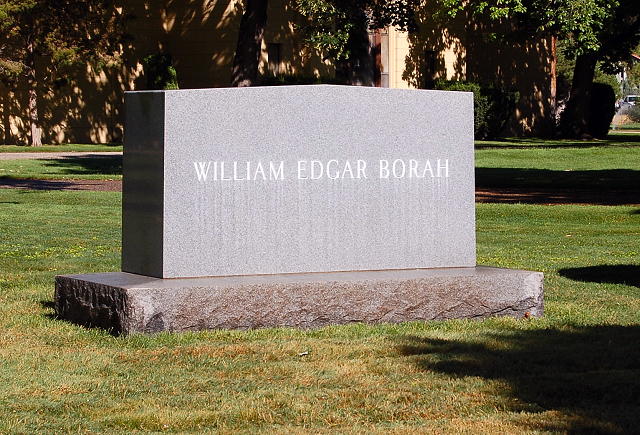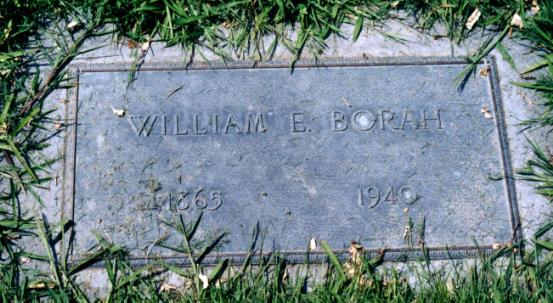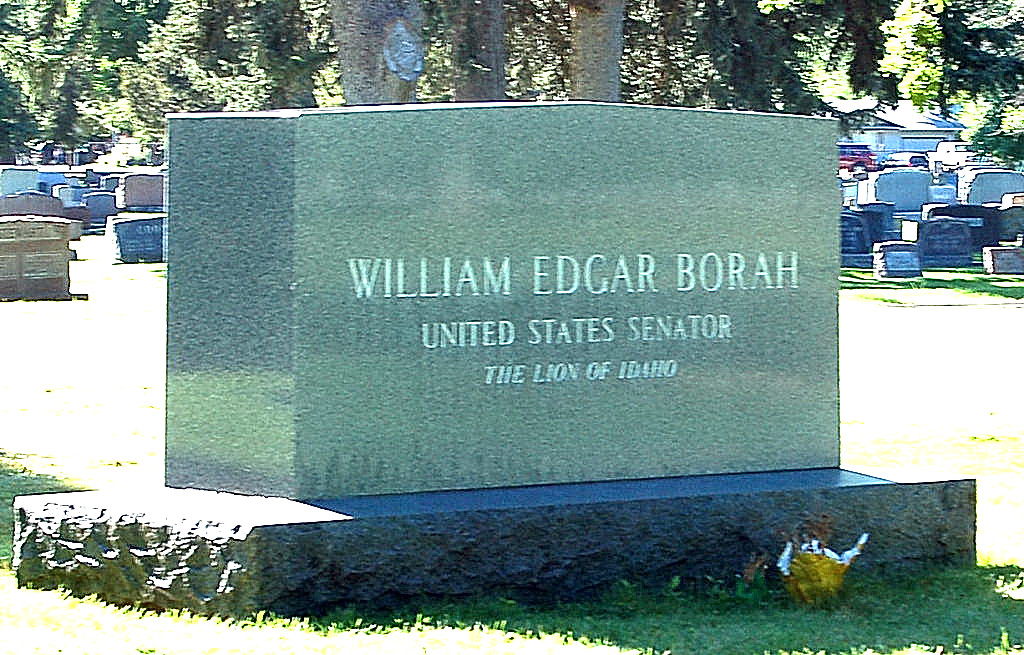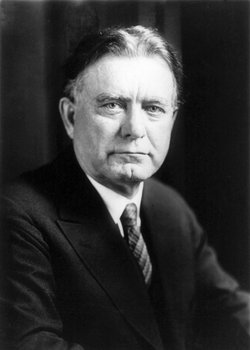
U.S. Senator. He gained recognition as an Isolationist Senator from Idaho, serving for thirty-three years. Known as the "Lion from Idaho," Borah served from March 4, 1907 to January 19, 1940, the day he died of a stroke while in office. One of only 16 progressives in the Senate at the time of his death, he was a noted "Isolationist." Offered the Vice-Presidential nomination by Calvin Coolidge, he declined. Borah lost his own bid for the Republican Presidential nomination in 1936 with newspaperman Frank Gannett as his running mate; Democrat Franklin D. Roosevelt was eventually elected President. Although an Isolationist, he voted for the United States to enter World War I. After the war, he led a group in the Senate who opposed the ratification of the Treaty of Versailles, which would have made the U.S. part of the League of Nations. After being an average student in a prairie school, he was sent to Southern Illinois Academy at Cumberland Presbyterian Academy in 1881 to become a minister, but was expelled in 1882. At that point, he joined a Shakespearean touring company, learning public speaking. In 1885, Borah enrolled at the University of Kansas while working part-time. In the winter of 1887, he had to leave college after being diagnosed with tuberculosis. While recuperating at home, he read law and passed the bar examination in September of 1887, entering into a law practice with his brother-in-law. In October of 1890, he boarded the Union Pacific Railroad in Omaha to relocate somewhere out west, and he decided to settle in Boise, Idaho. This was the same year Idaho became a state. He became a dramatic prosecutor, becoming a prominent legal figure, and soon began a political career. He was a superb orator who had a knack for courting publicity and was once named by "Time" magazine as the "most famed senator of the century."
U.S. Senator. He gained recognition as an Isolationist Senator from Idaho, serving for thirty-three years. Known as the "Lion from Idaho," Borah served from March 4, 1907 to January 19, 1940, the day he died of a stroke while in office. One of only 16 progressives in the Senate at the time of his death, he was a noted "Isolationist." Offered the Vice-Presidential nomination by Calvin Coolidge, he declined. Borah lost his own bid for the Republican Presidential nomination in 1936 with newspaperman Frank Gannett as his running mate; Democrat Franklin D. Roosevelt was eventually elected President. Although an Isolationist, he voted for the United States to enter World War I. After the war, he led a group in the Senate who opposed the ratification of the Treaty of Versailles, which would have made the U.S. part of the League of Nations. After being an average student in a prairie school, he was sent to Southern Illinois Academy at Cumberland Presbyterian Academy in 1881 to become a minister, but was expelled in 1882. At that point, he joined a Shakespearean touring company, learning public speaking. In 1885, Borah enrolled at the University of Kansas while working part-time. In the winter of 1887, he had to leave college after being diagnosed with tuberculosis. While recuperating at home, he read law and passed the bar examination in September of 1887, entering into a law practice with his brother-in-law. In October of 1890, he boarded the Union Pacific Railroad in Omaha to relocate somewhere out west, and he decided to settle in Boise, Idaho. This was the same year Idaho became a state. He became a dramatic prosecutor, becoming a prominent legal figure, and soon began a political career. He was a superb orator who had a knack for courting publicity and was once named by "Time" magazine as the "most famed senator of the century."
Bio by: Linda Davis
Family Members


-
![]()
Mary Alice Borah Crews
1847–1936
-
![]()
Infant Son Borah
1851–1851
-
![]()
Oliver Perry Borah
1852–1914
-
![]()
Hettie Borah
1860–1884
-
![]()
Sarah B. "Sadie" Borah Mabry
1861–1941
-
Susan J "Sue" Borah Lasley
1862–1933
-
![]()
Martha C. "Mattie" Borah Rinard
1863–1950
-
![]()
Charles Frank Borah
1867–1933
-
![]()
Caroline M. "Callie" Borah Baker
1870–1892
-
Infant Daughter Borah
1875–1875