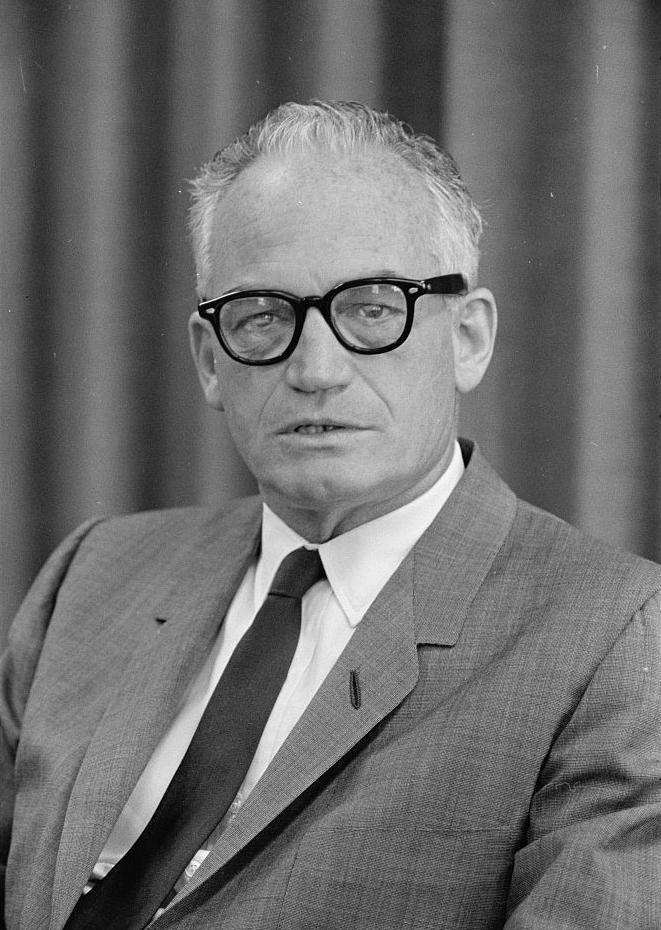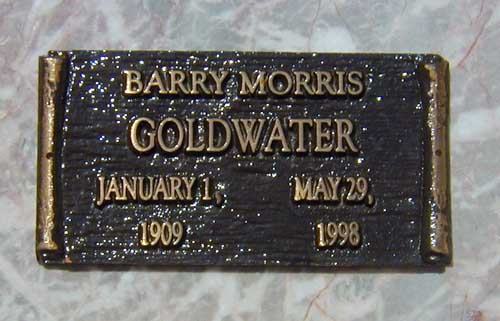
U.S. Senator. He served in the United States Army Air Corps during World War II as a Lieutenant Colonel and pilot making supply runs in the Asian Theatre (he remained in the Air Force Reserves and retired with the rank of Major General in 1962). He was elected as a Republican Senator from Arizona to the United States Senate, serving first from 1953 to 1965, then from 1969 to 1987. In 1964, he was the Republican nominee for United States President, running with New York Congressman William E. Miller as his Vice-Presidential Candidate. He lost the election to incumbent President Lyndon B. Johnson, who soundly defeated him by a wide margin. When he retired from the Senate in 1987, he had served a total of 30 years. He died in Paradise Valley, Arizona, in 1998. His son, Barry M. Goldwater Jr., served as a Congressman from California. Senator Barry Goldwater played a significant role in advocating for the recognition of the Women Airforce Service Pilots (WASP) as veterans, a process that culminated in 1977. The WASP were a group of civilian women pilots who flew military aircraft during World War II under the direction of the United States Army Air Forces. Despite their critical contributions—ferrying planes, testing aircraft, and training male pilots—they were not granted military status during the war and were disbanded on 20 Dec 1944 without veteran benefits. Goldwater, a Republican senator from Arizona and a former World War II Air Force pilot himself, had a deep appreciation for aviation and military service. He became a key supporter of the WASP Militarization Committee, a group formed to lobby for the recognition of WASP members as veterans, which would grant them access to benefits like healthcare, education, and burial rights through the Veterans Administration. In his capacity as a senator, Goldwater worked closely with the WASP Militarization Committee, which was led by former WASP members like Colonel Bruce Arnold (son of General Hap Arnold, who had overseen the WASP program during the war) and supported by other advocates. Goldwater used his influence in Congress to push for legislation that would retroactively grant military status to the WASP. He was instrumental in raising awareness about their contributions, often speaking publicly about their service and the injustice of their lack of recognition. His military background and conservative credentials gave him credibility among lawmakers who might have otherwise been skeptical of granting such status to a group of women who had served in a non-combat role. Goldwater co-sponsored and supported the key legislation, specifically the G.I. Bill Improvement Act of 1977 (Public Law 95-202), which included a provision to recognize the WASP as veterans. He worked alongside other lawmakers, such as Representative Lindy Boggs, and leveraged his position on committees like the Senate Armed Services Committee to ensure the bill gained traction. His advocacy helped overcome resistance from some quarters, including concerns from the Veterans Administration about the precedent of recognizing civilian groups as veterans. The group photograph that has been uploaded to this memorial likely depicts a meeting or celebration related to this effort, possibly in Goldwater's office, given the setting and the presence of multiple women who were former WASP flyers later working over the 5 year period in the late 70's to win military veteran status in 1977. The numerous framed photos on the wall, which appear to be of family or significant moments, align with Goldwater's known personal style in his Senate office, often filled with mementos of his life and career. In summary, Barry Goldwater's role was as a legislative advocate and sponsor, using his position as a senator to champion the WASP cause, collaborate with the WASP Militarization Committee, and help secure their veteran status in 1977. His efforts were pivotal in ensuring these women received the recognition they deserved for their wartime service.
U.S. Senator. He served in the United States Army Air Corps during World War II as a Lieutenant Colonel and pilot making supply runs in the Asian Theatre (he remained in the Air Force Reserves and retired with the rank of Major General in 1962). He was elected as a Republican Senator from Arizona to the United States Senate, serving first from 1953 to 1965, then from 1969 to 1987. In 1964, he was the Republican nominee for United States President, running with New York Congressman William E. Miller as his Vice-Presidential Candidate. He lost the election to incumbent President Lyndon B. Johnson, who soundly defeated him by a wide margin. When he retired from the Senate in 1987, he had served a total of 30 years. He died in Paradise Valley, Arizona, in 1998. His son, Barry M. Goldwater Jr., served as a Congressman from California. Senator Barry Goldwater played a significant role in advocating for the recognition of the Women Airforce Service Pilots (WASP) as veterans, a process that culminated in 1977. The WASP were a group of civilian women pilots who flew military aircraft during World War II under the direction of the United States Army Air Forces. Despite their critical contributions—ferrying planes, testing aircraft, and training male pilots—they were not granted military status during the war and were disbanded on 20 Dec 1944 without veteran benefits. Goldwater, a Republican senator from Arizona and a former World War II Air Force pilot himself, had a deep appreciation for aviation and military service. He became a key supporter of the WASP Militarization Committee, a group formed to lobby for the recognition of WASP members as veterans, which would grant them access to benefits like healthcare, education, and burial rights through the Veterans Administration. In his capacity as a senator, Goldwater worked closely with the WASP Militarization Committee, which was led by former WASP members like Colonel Bruce Arnold (son of General Hap Arnold, who had overseen the WASP program during the war) and supported by other advocates. Goldwater used his influence in Congress to push for legislation that would retroactively grant military status to the WASP. He was instrumental in raising awareness about their contributions, often speaking publicly about their service and the injustice of their lack of recognition. His military background and conservative credentials gave him credibility among lawmakers who might have otherwise been skeptical of granting such status to a group of women who had served in a non-combat role. Goldwater co-sponsored and supported the key legislation, specifically the G.I. Bill Improvement Act of 1977 (Public Law 95-202), which included a provision to recognize the WASP as veterans. He worked alongside other lawmakers, such as Representative Lindy Boggs, and leveraged his position on committees like the Senate Armed Services Committee to ensure the bill gained traction. His advocacy helped overcome resistance from some quarters, including concerns from the Veterans Administration about the precedent of recognizing civilian groups as veterans. The group photograph that has been uploaded to this memorial likely depicts a meeting or celebration related to this effort, possibly in Goldwater's office, given the setting and the presence of multiple women who were former WASP flyers later working over the 5 year period in the late 70's to win military veteran status in 1977. The numerous framed photos on the wall, which appear to be of family or significant moments, align with Goldwater's known personal style in his Senate office, often filled with mementos of his life and career. In summary, Barry Goldwater's role was as a legislative advocate and sponsor, using his position as a senator to champion the WASP cause, collaborate with the WASP Militarization Committee, and help secure their veteran status in 1977. His efforts were pivotal in ensuring these women received the recognition they deserved for their wartime service.
Bio by: RPD2