
Who grades the grader? Mutation testing for the verifier of a live SRE benchmark.
SREMut audits the verifier of the SREGym benchmark, not the agents it evaluates. It asks one question: can SREGym's mitigation oracle be satisfied by a system that was never repaired?
For the missing_service family, the answer is yes. The method is classic mutation testing pointed at a grader: apply a controlled operational mutant to a healthy deployment, run the unchanged stock oracle, and run a stronger operational contract that was frozen and timestamped before execution. The disagreement between the two graders is the finding.
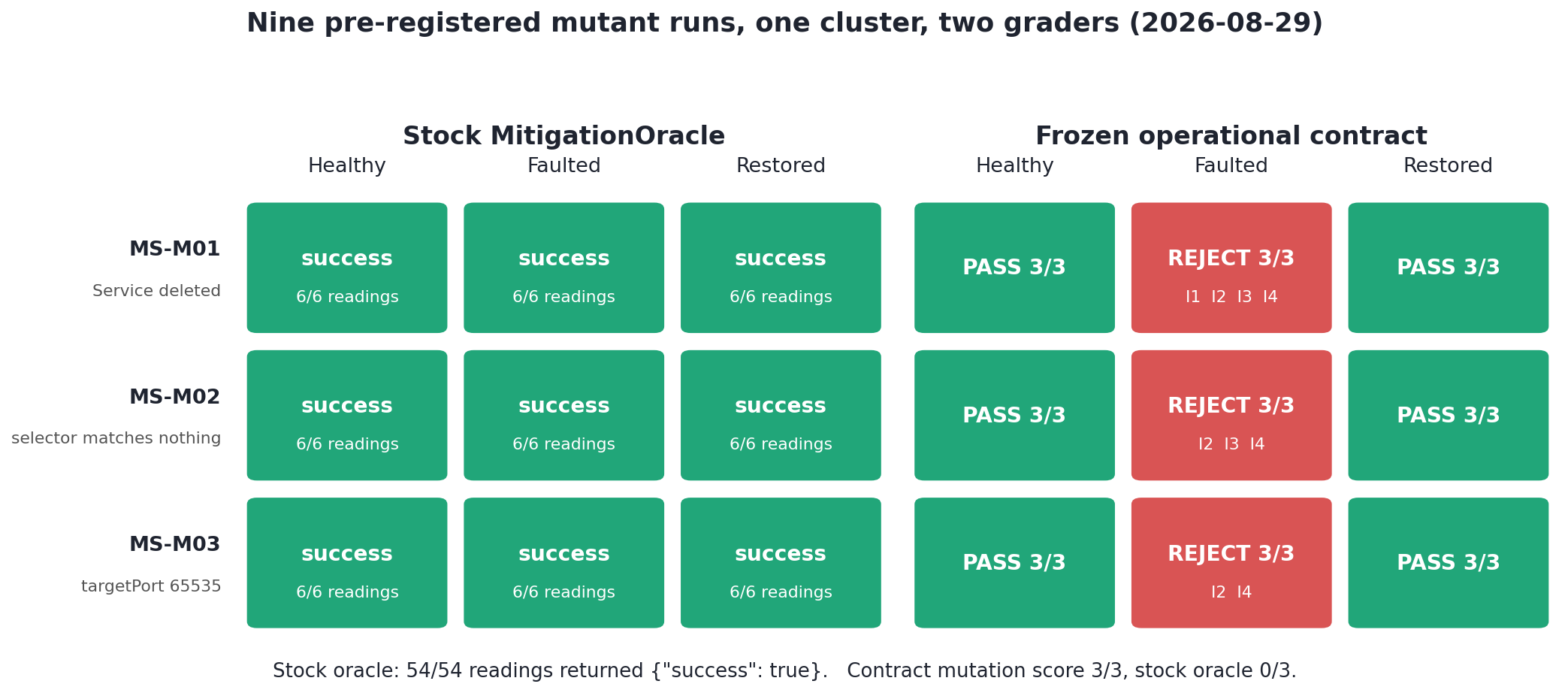
Three Service-level mutants, three repetitions each, executed 2026-08-29 on a live kind cluster. Every prediction was frozen and RFC 3161 timestamped before the first mutant was applied.
| Mutant | What it does | Faulted non-2xx | Successful-response volume retained | Stock oracle | Contract |
|---|---|---|---|---|---|
| MS-M01 | delete Service/user-service |
9.88 to 9.97% | 90.02% | success 6/6 faulted | REJECT 3/3 (I1 I2 I3 I4) |
| MS-M02 | selector matches no pods | 6.81 to 9.84% | 9.19% | success 6/6 faulted | REJECT 3/3 (I2 I3 I4) |
| MS-M03 | targetPort set to 65535 |
9.75 to 10.05% | 90.11% | success 6/6 faulted | REJECT 3/3 (I2 I4) |
54 of 54 stock oracle readings returned {"success": true}. The contract rejected 9 of 9 faulted states and passed all 18 healthy and restored controls on the five invariants evaluated. Mutation score: contract 3/3, stock oracle 0/3. Violated invariant sets were identical across all three repetitions of each mutant. Nine completed records, with no recorded exclusions or retries, 93.3 minutes of driver wall clock. See DEVIATIONS_AND_LIMITS.md.
This study evaluated MS-I1 through MS-I5; MS-I6 (repair persistence) was declared out of scope in advance by §6 of the pre-registration. A REJECT is unaffected by that, since a sixth invariant can only add violations, so "REJECT 9 of 9" and the 3/3 mutation score hold for the full contract. The control results do not carry over: the six-invariant contract has never been shown to pass a genuine repair.
Retained volume above is the fully post-mutation figure: every run's first faulted round began before the mutant was applied and may contain pre-mutation traffic, so it is dropped and the remaining nine rounds are compared per round against the healthy window's ten. The full-window sensitivity values, first round included, are 90.07%, 13.29% and 90.14%; the difference is material only for MS-M02, whose straddling first round carries a disproportionate share of its surviving traffic. Both are emitted per run and per mutant by experiments/MUTANT_LEDGER.json.
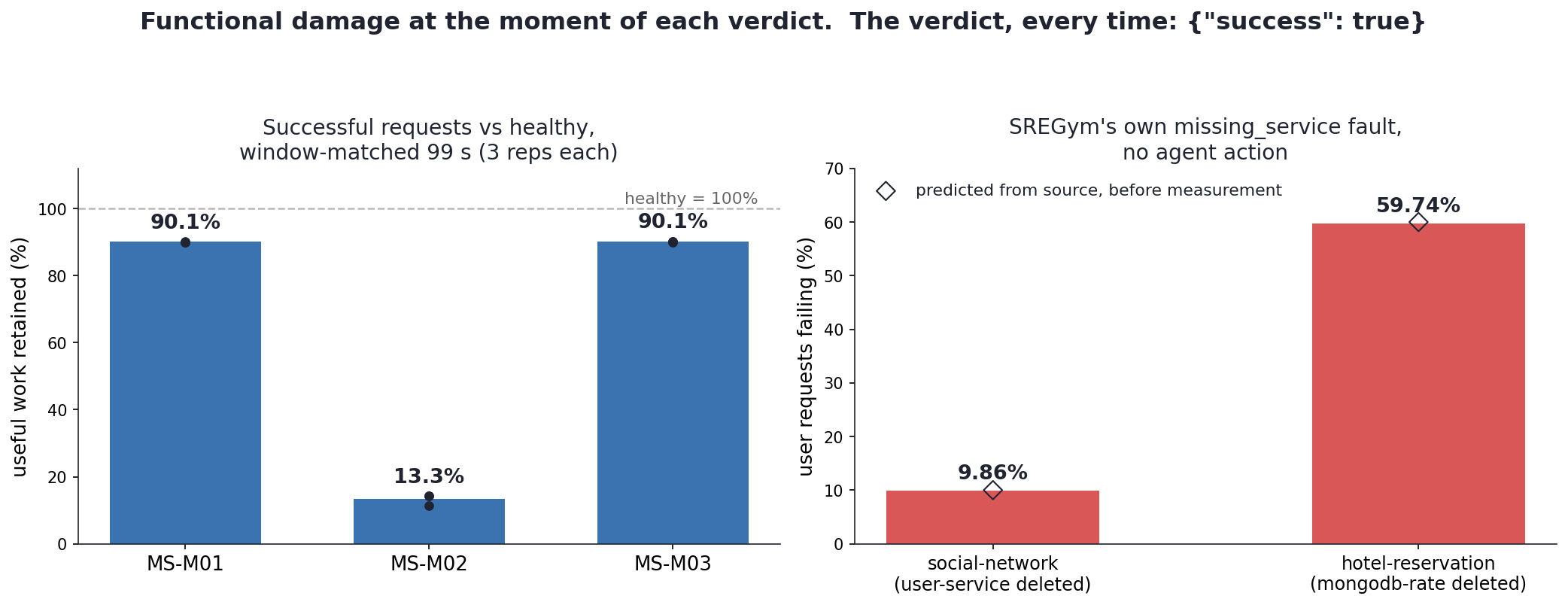
Every categorical prediction in the pre-registration matched, including the per-mutant invariant sets. The one quantitative miss: about 10% non-2xx was predicted for all three mutants, but MS-M02 collapsed throughput to a small fraction of healthy request volume, so its error rate sat on a much smaller denominator. Successful-response volume retained tells that story honestly: about 9% for M02 versus about 90% for the others. It is a count of successful HTTP responses, not a measure of application work.
Attestation chain, all on 2026-08-29, tokens from Free TSA, verifiable offline with openssl ts: pre-registration document hashed and timestamped at 09:08:34 UTC, pre-execution commit SHA timestamped at 10:15:38 UTC, first mutant applied at 10:22:09 UTC. See PREREGISTRATION_MS_MUTANTS.md and attestation/.
Before the mutant study, 13 exploratory runs used SREGym's own missing_service injector with a null agent that does nothing. Every faulted state that was ever read, including the runs later excluded for instrument defects, got the same verdict: 21 of 21 faulted readings returned {"success": true}, across two applications and the production path through the real Conductor.
| Application | Deleted Service | Predicted failure rate | Observed | Verdict |
|---|---|---|---|---|
| social-network | user-service |
10.0000% | 9.8639% | {"success": true} |
| hotel-reservation | mongodb-rate |
60.0000% | 59.7429% | {"success": true} |
Both rates were derived from workload source before measurement (compose-post is 10% of the mix and the only path to user-service; search is 60% and the only path to mongodb-rate). Recovery through SREGym's own recover_fault() returns both to 0.0000%, which pins the failures on the injected fault. The verdict did not move at either damage level.
Two facts compose. The stock MitigationOracle reads Deployments and Pods only: no Services, Endpoints, selectors, ports, DNS, sockets, HTTP, or workload, each absence provable by grep, and the gap is admitted in the oracle's own docstring at mitigation.py:26. And the fault injector restores exactly that surface: inject_missing_service deletes the Service, then runs kubectl delete pods --all and waits for stability, so by grading time every Deployment and Pod the oracle can see is healthy again while the Service is still gone.
The same mechanism recurs in a second fault class: auth_miss_mongodb's injector scales its client back up itself, restoring the replica count the oracle checks, while the client sits in an unbounded retry loop and never starts serving. With no readiness probes anywhere in the chart, that pod still looks fine (source-level finding, not yet executed).
A census of all 123 problem IDs registered at the pinned commit, classified by whether the attached oracle can observe what its injector perturbs.
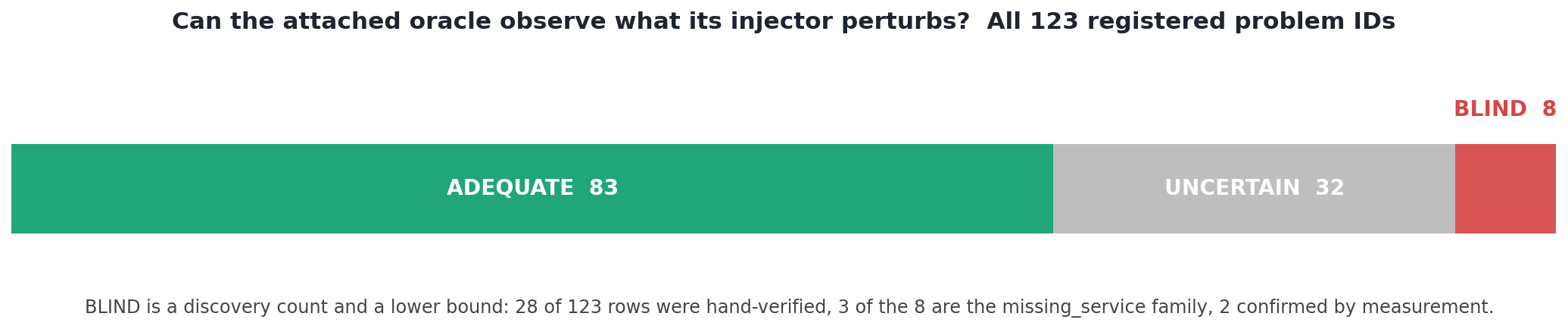
The 8 BLIND: missing_service_social_network, missing_service_hotel_reservation, missing_service_astronomy_shop, assign_to_non_existent_node, auth_miss_mongodb, operator_wrong_operator_image, pvc_claim_mismatch, workload_imbalance. Two carry a dedicated oracle, so blindness is not just a generic-oracle problem. The count is a lower bound from 28 hand-verified rows, not a prevalence estimate, and 32 rows remain UNCERTAIN. Full method, corrections, and disclosed errors in analysis/census/CENSUS.md.
Three secondary defects, each with file:line citations in analysis/census/secondary-defects.md:
| ID | Defect | Direction |
|---|---|---|
| D1 | run-oracle.py evaluates without capture_baseline(), silently skipping all Deployment predicates for 31 bare-generic problem IDs, 35 including the four subclasses |
false accept |
| D2 | namespace-wide pod sweep counts benchmark infrastructure; failed wrk2 husks persisted 9+ days and never self-clear | false reject |
| D3 | WrongUpdateStrategyMitigationOracle.evaluatePods() defined but never called |
false accept |
Four added lines and one changed line in missing_service.py: compose the existing oracle with ServiceEndpointMitigationOracle, which already lives upstream and is already used for the adjacent wrong_service_selector problem.
self.expected_service_port = <port of the deleted Service>

self.mitigation_oracle = CompoundedOracle(
    self,
    MitigationOracle(problem=self),
    ServiceEndpointMitigationOracle(problem=self),
)
This composition has now been evaluated as an in-process prototype. Three runs on 2026-08-29 evaluated four oracle configurations in all three states of each mutant, against a prediction table frozen and RFC 3161 timestamped before the driver was written. All 20 predicted cells matched.
| Configuration | healthy | M01 | M02 | M03 | restored |
|---|---|---|---|---|---|
stock MitigationOracle |
success | success | success | success | success |
ServiceEndpointMitigationOracle alone, unpatched |
reject | reject | reject | reject | reject |
the same, with expected_service_port set |
success | reject | reject | reject | success |
| the composed prototype | success | reject | reject | reject | success |
The unpatched oracle rejects correct repairs. Attaching it without setting expected_service_port makes it reject the healthy and restored systems too, by AttributeError at service_endpoint_mitigation.py:65, captured verbatim in all nine diagnostic calls. Substituting it would trade a false accept for a false reject.
The composed prototype, with the port set, accepted every healthy and restored state and rejected every mutant. That is an evaluated result rather than a prediction, and it is not the same as having applied the patch upstream. The benchmark source was never modified: the composition was constructed inside our own driver, expected_service_port was set on the problem object at runtime, and SREGym's conductor path was never exercised. What is evidenced is the behaviour of the composed oracle against these cluster states, not the behaviour of a patched SREGym.
SREGym/ was not modified. expected_service_port is set on the problem object in our own process and deleted afterwards, reproducing the patch's object state at evaluate time; git -C SREGym status is clean in every run and the four pinned SREGym module hashes are recorded in every record.
Full comparison against the frozen table, the timing evidence locating each rejection, and the limits: ADJUDICATION_FIX_ORACLE.md. Analysis and the port caveat in analysis/PR_PLAN.md. An upstream disclosure and PR are planned.
| Item | Value |
|---|---|
| SREGym / applications | ba07faf1 / 2b2f9c6c, read-only, never modified |
| Cluster | kind v0.32.0, Kubernetes v1.32.0, 4 nodes, kubectl pinned 1.32.0 |
| Runtimes | both instruments ran under SREGym/.venv (CPython 3.12.3, kubernetes 30.1.0). The in-process oracle and the isolated worker subprocess differ in call path, not in client library. The CPython 3.12.3 + kubernetes 32.0.1 runner is the sealed SREMut runtime: specified, not materialised, and not used by any run reported here |
| Host | GCP e2-standard-8, Ubuntu 24.04 |
# one three-state null-agent run (~9 min social-network, ~18 min hotel-reservation)
~/sremut/SREGym/.venv/bin/python experiments/three_state_run.py --run-id my-run-01

# one pre-registered mutant run
~/sremut/SREGym/.venv/bin/python experiments/mutant_run.py --run-id ms-m01-rXX --mutant MS-M01

# one fix-oracle run: four oracle configurations x three states
~/sremut/SREGym/.venv/bin/python experiments/fix_oracle_run.py --run-id fix-m01-rXX --mutant M01
The fix study is fix-m01-r01, fix-m02-r01, fix-m03-r01, evidence in experiments/fix-m0*-r01/fix-oracle-run.json and the ledger in experiments/FIX_ORACLE_LEDGER.json (regenerate with build_fix_oracle_ledger.py --check). Its attestation chain: the prediction document was timestamped at 15:16:02 UTC, before fix_oracle_run.py existed, and the pre-execution tree at 15:53:19 UTC, with the first run starting at 15:54:03 UTC. Adjudication against the frozen table: ADJUDICATION_FIX_ORACLE.md.
Every number above traces to a file in this repo. Start at analysis/PAPER_NUMBERS.md; the mutant evidence lives in experiments/ms-m0*-r0*/mutant-run.json, the historical ledger in experiments/RESULT_LEDGER.json (regenerate with build_result_ledger.py --check).
src/sremut/     evidence capture, guarded mutation, adjudication, sealing
contracts/      frozen operational contract (invariants MS-I1..MS-I6)
mutants/        frozen mutant registry
attestation/    RFC 3161 tokens and verification steps
analysis/       verdict-path trace, census, PR plan, pre-registration forensics
experiments/    protocols, drivers, and all run evidence
- Everything here is a mitigation verdict and only that: not a diagnosis score, not an agent score, not an overall SREGym result.
- Two studies are confirmatory: the nine-repetition mutant matrix and the three-run fix-oracle study, each with its predictions frozen and RFC 3161 timestamped before the driver that measured them was written, and each adjudicated once against its frozen table. The 13 historical runs are exploratory: their protocols lack independent pre-execution corroboration, and
analysis/PREREGISTRATION_TIMELINE.mddocuments exactly what git does and does not attest. - Two applications measured, one cluster.
missing_service_astronomy_shopand the other BLIND rows outsidemissing_serviceare structural predictions, never executed. Hotel-reservation is n=1, single instrument. - The census was verified to unequal depth (28 of 123 rows hand-checked), and ADEQUATE is structural: the oracle reads the perturbed kind, which is not proof it rejects non-repairs.
- The proposed fix has been evaluated as an in-process prototype against the live cluster (three runs, 2026-08-29). It has not been applied to SREGym, submitted upstream, or validated through SREGym's own conductor:
SREGym/was never modified, the composition was built in our driver, and the attribute was set on the problem object at runtime. - Every deviation from the frozen pre-registration and every limit on the nine records, including the first faulted workload round straddling the mutation, the unretained wrk2 logs and the shared Kubernetes client, is recorded in
DEVIATIONS_AND_LIMITS.md. - The fix study is single-provenance (in-process only, no isolated-worker leg) with one repetition per mutant, and it evaluates oracle behaviour rather than establishing cluster state; the frozen contract and the workload window do that independently in every state of every run.
- Three distinct studies exist and should not be conflated. The pre-registered nine-repetition MS-I1..MS-I5 mutant study is complete (9/9). The pre-registered fix-oracle study is complete (3/3), adjudicated in
ADJUDICATION_FIX_ORACLE.md. The sealed v1.2 six-invariant matrix, with authenticated run identities, a hash-chained journal and an external anchor, remains 0/9 and unexecuted; the word "official" and the statusOFFICIAL_FROZEN_ATTEMPTstay reserved for it.
The measurement code and the evidence records in this repository are MIT-licensed; see LICENSE. No third-party asset is redistributed here: the audited benchmark (SREGym) and its applications are third-party work, cited and pinned by commit rather than vendored, and are obtained separately.
A write-up is under review at a NeurIPS 2026 workshop. Errors found along the way, including our own, are disclosed rather than silently fixed: see the census corrections and the disclosed-errors table in analysis/census/CENSUS.md.