Repository navigation
ports/stm32/can.c: allow mixed id-type bus #3916
Description
Activity
- changed the title
[-]stm32/can.c: allow mixed id-type bus[/-][+]ports/stm32/can.c: allow mixed id-type bus[/+]on Jul 2, 2018 I think this is quite an important fix for CAN comms...
Mixing extended and standard addressing is quite common, especially considering most developer diagnostics tools use extended ID's (to reduce the risk of clashing in the address-space).Workaround
One (pretty awful) workaround in the meantime is to use both thepyboard's CAN channels, one configured for extended ids, the other for standard.The user jgui (on the micropython forum) posted an excellent high-level test report on [Nov 21, 2016]
ref: https://forum.micropython.org/viewtopic.php?t=2686 paraphrased below...I have tested several configurations to understand, using CAN1 to send messages to CAN2, and changing CAN1/CAN2 configuration each test.
Wiring Diagram

Test Table & Results
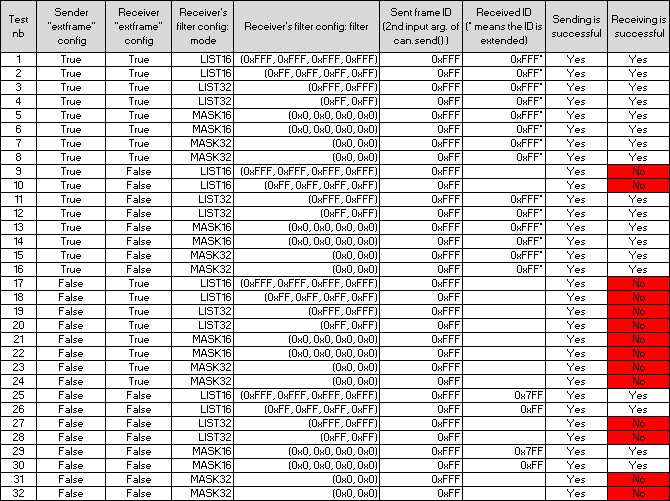
Thanks for raising this point. I agree it should be possible to send both base and extended frames without reconfiguring the CAN object.
Therefore, the flag in CAN.init() should be changed to indicate whether or not the bus allows extended ID and CAN.send() should be modified to accept a flag to indicate standard vs extended ID and throw if an extended-message is attempted to be sent on a standard-only bus.
When receiving it should already support a mix of extended frames or not, regardless of the
extframesetting.extframeonly affects sending of frames.To maintain backwards compatibility we'd need to keep the meaning of
extframein theinit()method. This would provide the default type of frame that is sent. ThenCAN.send()could also take this same parameter which would override the default. Eg:can = CAN(1, CAN.NORMAL, extframe=False) # default to base frames can.send('data', 45) # use base frame can.send('data, 45, extframe=True) # use extended frame
That seems pretty obvious. I can't think of a simpler or cleaner way to do it. (Autodetecting whether it's base or extended by the size of the address wouldn't work because you could have an address of 1 even in an extended frame.)
Reacted by Peter BoinTo maintain backwards compatibility we'd need to keep the meaning of extframe in the init() method. This would provide the default type of frame that is sent. Then CAN.send() could also take this same parameter which would override the default. Eg:
Then it's not possible to enforce that a given bus can only send standard-frames (or extended frames).
To maintain backwards compatibility, add another argument to constructor called
allowOverride:allowOverride == 1->can.sendis allowed to send frames different fromextframedefaultallowOverride == 0 (default)->can.sendis NOT allowed to send frames different fromextframedefault
Then it's not possible to enforce that a given bus can only send standard-frames (or extended frames).
I don't think it's really necessary to support this behaviour. The user has to go out of their way to explicitly send an extended or basic frame when calling
can.send(), so it can't happen "by accident". And since the CAN bus should always be able to handle extended frames (at least ignore them) I don't see a need to really forbid it in the software.Reacted by Peter BoinYou’re assuming only ONE user has complete control over all layers of the code.
Scenario: one user creates a layer that initializes the bus and then another user - through another layer like a remote API - attempts to send a message using a message type that’s incompatible given current configuration.
I can’t control the remote code the other author writes so I would have to maintain additional state and checks that could and should be done by the CAN object itself.
You’re assuming only ONE user has complete control over all layers of the code
Well, I'm assuming that if a user has the
caninstance and can callcan.send()then the can also callcan.init()and change the configuration. So they could change whether extended frames are allowed or not.one user creates a layer that initializes the bus and then another user - through another layer like a remote API - attempts to send a message using a message type that’s incompatible given current configuration.
In such a case you'll also need to prevent the other user from calling
can.init().I can’t control the remote code the other author writes so I would have to maintain additional state and checks that could and should be done by the CAN object itself.
In this case it'd be better to wrap the CAN object to expose only the things you want to expose.
your
allowOverridebehaviour could be achieved with something like:import pyb class MyCAN(pyb.CAN): def __init__(self, *args, allowOverride=False, **kwargs): self.allowOverride = allowOverride super(MyCAN, self).__init__(*args, **kwargs) def send(self, *args, **kwargs): if not self.allowOverride and kwargs.get('extframe', self.extframe) != self.extframe: raise RuntimeError("you can't just change extframe behavior like that!, get off my bus!") return super(MyCAN, self).send(*args, **kwargs)
Then use
MyCANinstead of thepyb.CANclass
That way you can administer that restriction onto other engineers.I know I can do that but that logic should be part of CAN module
but that logic should be part of CAN module
Why exactly? What about other (arbitrary) restrictions like on the maximum number of bytes to send, or on the addresses that you can send to, etc? And even if CAN does restrict the extended frame format, how will you prevent users from reconfiguring it via
can.init()?This is not an arbitrary restriction.
It has to do with what the bus itself supports given the capabilities of other modules and therefore is a property of the bus like bitrate.
If modules transmit at different bitrates bus won’t work. If modules transmit extended but some modules start ERRoring because they can’t handle it, bus won’t work.Reconfiguring the frame type is no different than reconfiguring the bitrate so your question’s answer is the same as “how will you prevent users from reconfiguring the bitrate”.
If modules transmit extended but some modules start ERRoring because they can’t handle it, bus won’t work.
From what I understand about CAN, anything on the bus must at least tolerate (eg ignore) extended frames, even if they don't support them.
Reconfiguring the frame type is no different than reconfiguring the bitrate so your question’s answer is the same as “how will you prevent users from reconfiguring the bitrate”.
So, how will you prevent them reconfiguring the bitrate?
From what I understand about CAN, anything on the bus must at least tolerate (eg ignore) extended frames, even if they don't support them.
That's my understanding as well... and Wikipedia's CAN bus page agrees:
The CAN standard requires the implementation must accept the base frame format and may accept the extended frame format, but must tolerate the extended frame format.
So, how will you prevent them reconfiguring the bitrate?
If I give them access to modify the bitrate, I should give them access to modify
extframeas they're both properties of the CAN bus . . . and if I deny them access to one, I should deny them access to the other.From what I understand about CAN, anything on the bus must at least tolerate (eg ignore) extended frames, even if they don't support them.
That's not technically true; see section 5
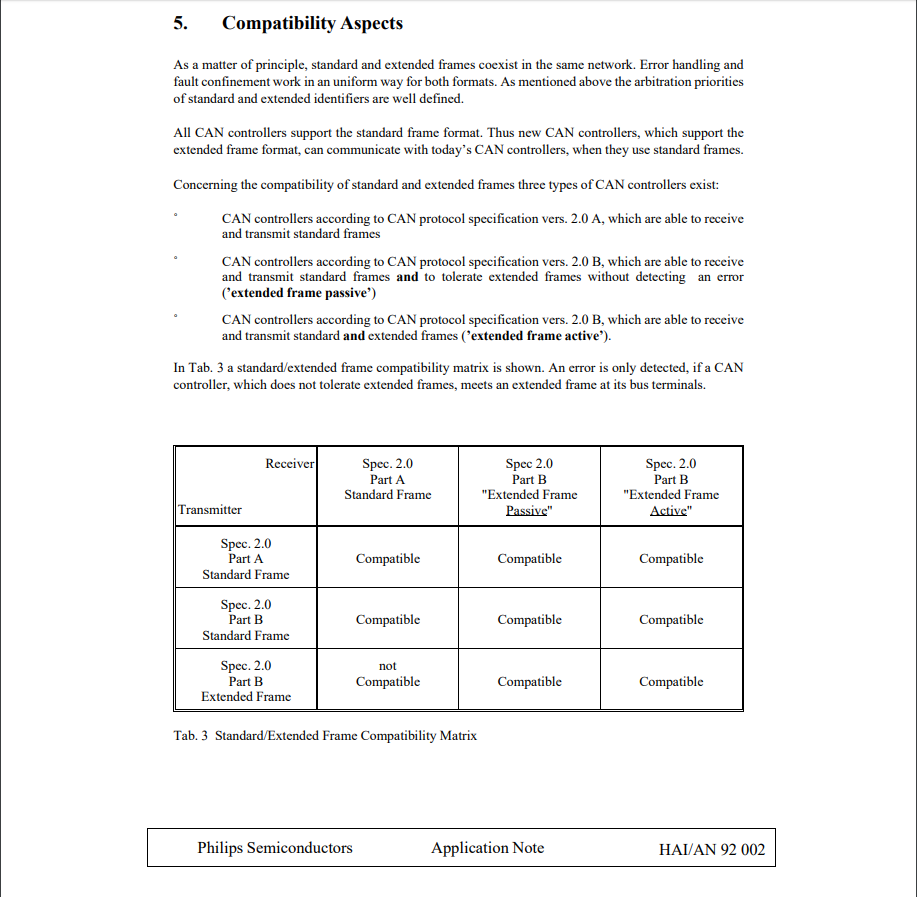
Maybe the silicon cost to implement tolerance for extended is so trivial that no one will ever encounter this situation but why leave this implementation gap at all if it's part of the spec?
As I see it there are two separate issues here:
- Whether an extended frame can lead to an error on the CAN bus with a CAN 2.0A controller.
- Whether the stm32's CAN implementation should prevent the user from sending extended frames in the send method if the frame type was configured to basic/standard frame.
As for issue 1, according to the CAN 2.0 specs found here http://esd.cs.ucr.edu/webres/can20.pdf, part A (ie CAN 2.0A controllers), section 3.1.1 on page 13 of the PDF, it states that there are two bits in the control field reserved for future expansion, and that these must be sent 'dominant' (indicating a standard frame). It also states that "receivers accept 'dominant' and 'recessive' bits in all combinations". So I read this as stating that CAN 2.0A controllers must ignore an extended frame. Furthermore in section 6 (error handling) none of the errors there correspond to reporting an error when an extended frame is detected.
That's not technically true; see section 5
It looks like this is an application note, not the CAN specs.
If I give them access to modify the bitrate, I should give them access to modify extframe as they're both properties of the CAN bus . . . and if I deny them access to one, I should deny them access to the other.
So, if you are explicitly denying them access to modify the bitrate and change extframe in the
init()method, then you can also deny them access to setting extframe in thesend()method, right?Ok you're right about the case of another user.
Even in the case of single-user, I view this proposed restriction it like theconstqualifier: it's there to prevent you from doing something accidentally.You don't need
constkeyword but it helps to document and enforce an intention.With some experience on using the CAN interface I think it was a mistake to put the extframe parameter in the init function. The interface as such should always be able to handle both standard and extended frames. The selection of which types to send and receive should have been delegated to the send,
receive and filtering functions.Reacted by Peter BoinThe interface as such should always be able to handle both standard and extended frames. The selection of which types to send and receive should have been delegated to the send,
receive and filtering functions.With the proposal (see above) to add the
extframekeyword to thesend()method, this would allow to send standard and extended frames easily.For
recv()it already supports standard and extended frames regardless of theextframesetting done at construction/initialisation. The only issue is that it doesn't inform you which frame type was received, it just gives you the id of the frame.For filtering, we could also add an
extframekeyword argument tosetfilter()to override the defaultextframejust like withsend().Passing an additional
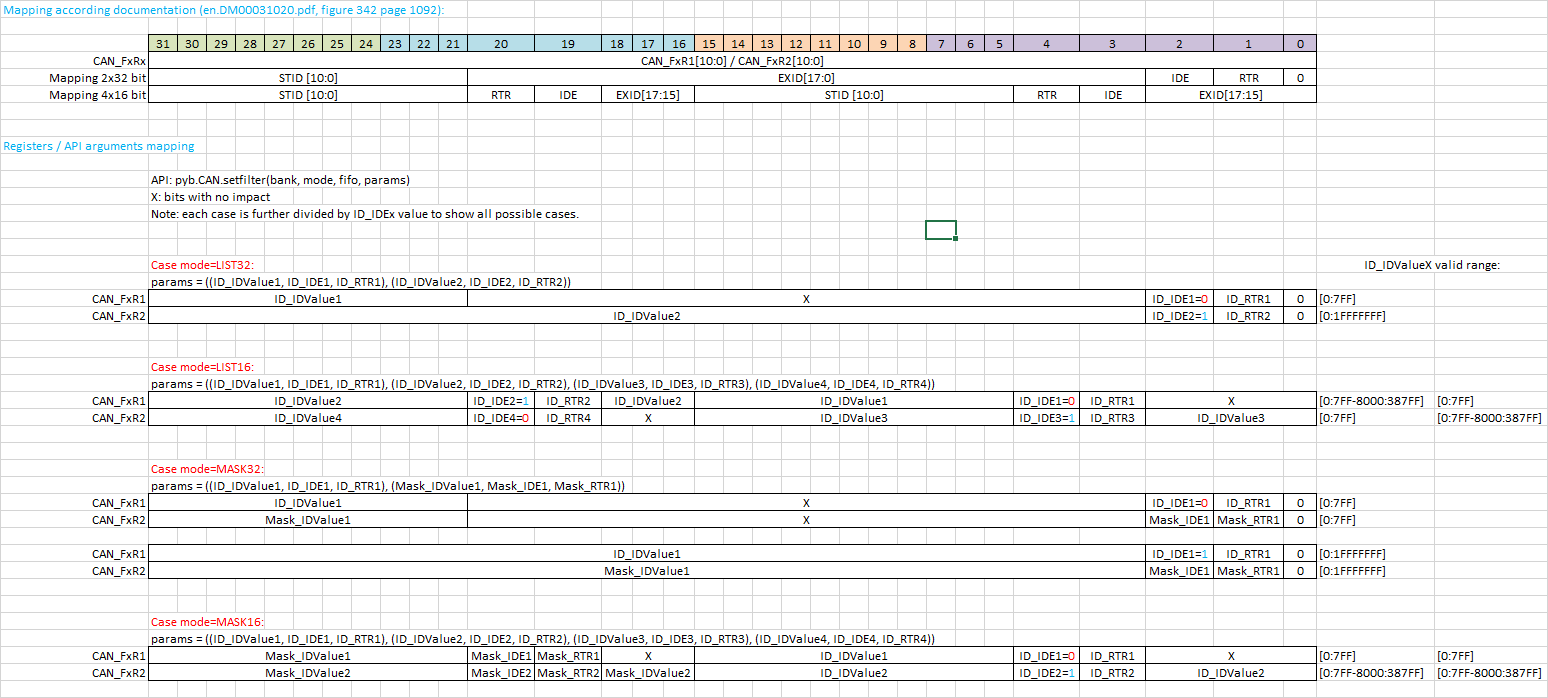
ide(orextframe) argument to CAN.setfilter (just asrtrargument) would clarify how to configure filter and how filter work.Also for filter mode
CAN.MASK16andCAN.MASK32, ability to mask IDE or RTR bit is not provided (only ID), and it is not clear how these bits are set by the API. From testing it is difficult to understand the exact logic, which seems to depend on filter mode andextframe. Adding 2 parameters for masking ide and rtr would clarify.Putting together new ide and mask parameters, API could become:
CAN.setfilter(bank, mode, fifo, params)
with:
-paramswhen mode is LIST16: ((ID_IDValue1, ID_IDE1, ID_RTR1), (ID_IDValue2, ID_IDE2, ID_RTR2), (ID_IDValue3, ID_IDE3, ID_RTR3), (ID_IDValue4, ID_IDE4, ID_RTR4))
-paramswhen mode is LIST32: ((ID_IDValue1, ID_IDE1, ID_RTR1), (ID_IDValue2, ID_IDE2, ID_RTR2))
-paramswhen mode is MASK16: ((ID_IDValue1, ID_IDE1, ID_RTR1), (Mask_IDValue1, Mask_IDE1, Mask_RTR1), (ID_IDValue2, ID_IDE2, ID_RTR2), (Mask_IDValue2, Mask_IDE2, Mask_RTR2))
-paramswhen mode is MASK32: ((ID_IDValue1, ID_IDE1, ID_RTR1), (Mask_IDValue1, Mask_IDE1, Mask_RTR1))with ID_IDValueX valid ranges:
- (LIST16 or MASK16) and ID_IDEx=0: [0:7FF]
- (LIST16 or MASK16) and ID_IDEx=1: [0:7FF-8000:387FF]
- (LIST32 or MASK32) and ID_IDEx=0: [0:7FF]
- (LIST32 or MASK32) and ID_IDEx=1: [0:1FFFFFFF]
An error should be generated when user set an ID or ID mask out of range.Here is a mapping with registers I made for my own understanding:


Original issue here on forum
Most CAN buses can handle messages with both extended- and standard-id but the current API does not allow mixed id-type bus.
micropython/ports/stm32/can.c
Lines 353 to 369 in 338af99
There could be hardware modules on the bus with varying degree of tolerance for even the presence of extended IDs:
While it does make sense to say this can bus can only accept standard-id, it doesn't make sense to say this can bus can only accept extended id because if you can accept extended then you can also accept standard.
Therefore, the flag in
CAN.init()should be changed to indicate whether or not the bus allows extended ID andCAN.send()should be modified to accept a flag to indicate standard vs extended ID and throw if an extended-message is attempted to be sent on a standard-only bus.