
English | 简体中文
Label a GitHub Issue. Get back a reviewed, merged PR — and a release.
Try Orbi Cloud — 3 merged deliveries free · no server, no credit card required
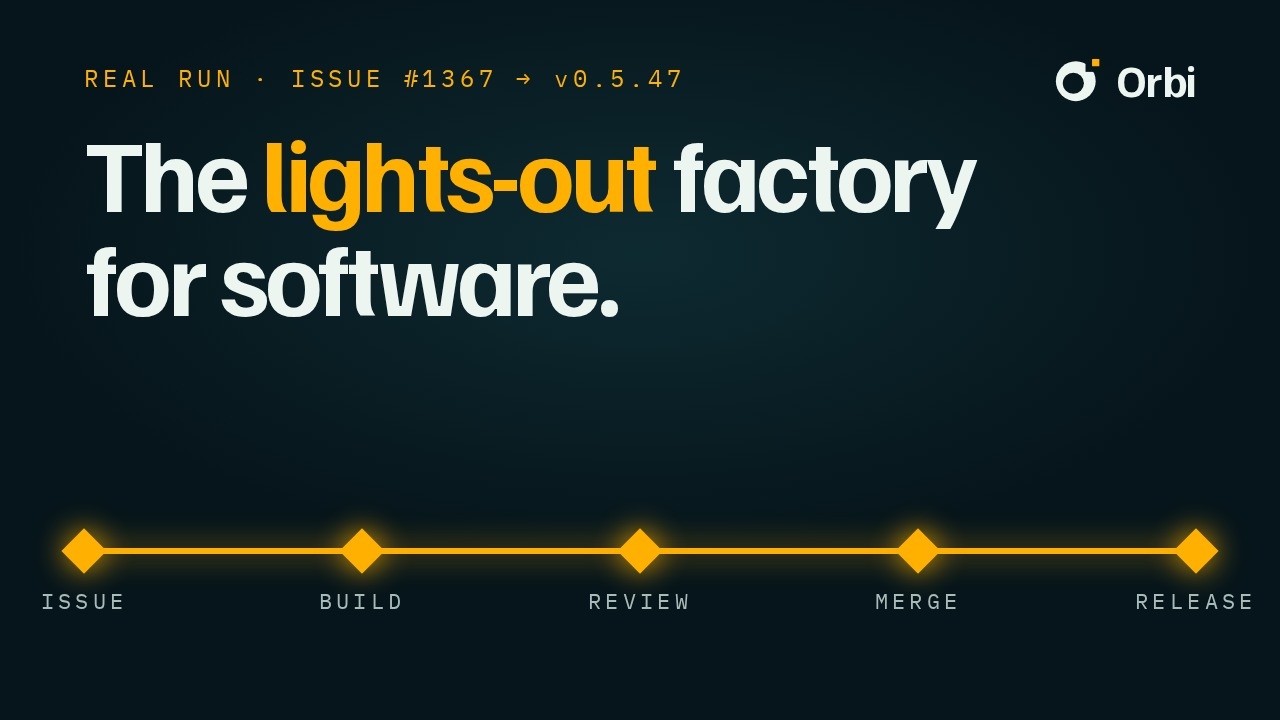
See one real loop: Issue #1367 → PR #1370 → Release v0.5.47
Orbi is an open-source autonomous coding agent: label a GitHub Issue ai-ready, and it writes the code in an isolated worktree, opens a PR, has an independent review session check it against the Issue's acceptance criteria, merges only the reviewed head, and cuts a tagged release. GitHub Issues are the only state store—no database, queue, or daemon.
Ledger: merged PRs · closed Issues · tagged releases — the repository is the record.
Website https://orbi.build | Documentation https://docs.orbi.build/ | Discussions | Docker GHCR · Docker Hub
Prefer to run it yourself? Follow the Quick start below. Cloud founding members get 50% off forever with the code FOUNDING50 at checkout (6 places).
git clone https://github.com/orbi-build/orbi.git && cd orbi
uv tool install --force --reinstall --editable --python python3 .  # compatible system Python (>= 3.14, e.g. Fedora 43 / current Arch); older (e.g. Ubuntu 24.04's 3.12): --python 3.14 so uv provisions it
Want just the CLI? It's on PyPI as orbi-cli (requires Python ≥ 3.14; the command stays orbi): uv tool install orbi-cli (older system Python: add --python 3.14 so uv provisions one) or pip install orbi-cli in a Python ≥ 3.14 environment; verify with orbi --version → orbi <version>, uninstall with uv tool uninstall orbi-cli. To run Orbi itself, use the one-line installer at the top of Getting started — it creates the editable install Orbi's deployment drives.
uv:uv --version; Pi and its provider:pi --version, thenpi --print "reply with the single word: ok"- GitHub CLI ≥ 2.94 (official repository — Ubuntu 24.04's package 2.45.0 is too old): run
gh auth loginonce, then verifygh auth status - Linux — systemd user session:
systemctl --user status - macOS — launchd GUI session:
launchctl print gui/$(id -u)(not yet verified on real hardware; reports welcome)
Choose the mode in Getting started: bootstrap uses this checkout as repo_dir; External single-repo mode uses it as deploy_home and a foreign repository as repo_dir.
cp src/orbi/example_config.toml orbi.toml
orbi setup --config orbi.toml  # 4. run one-time setup (checks prior gh auth, labels, scheduler units (systemd/launchd), and checkout; idempotent)
PYTHONPATH=src python3 -m orbi.runner --config orbi.toml  # 5. manually run one tick (for initial verification; the timer schedules normal runs)
orbi doctor --config orbi.toml # 6. verify deployment healthThat same loop, recorded from the live GitHub pages — including the review that rejected the first attempt:
orbi-loop.mp4
- An issue — a bug, labelled
ai-ready - It writes the code — PR #1023, on a recorded base SHA
- The review says no — one Major finding, naming
src/orbi/release.py:2377and the fix - It fixes itself — more commits, until the checks go green
- It merges — 9 commits, +427/−43, only after the review passed
- A tagged release — v0.5.17, with the Issue and PR in the notes
- GitHub Issues are the task pool: the
ai-readylabel dispatches work, and the delivery record (comments, PRs, and CI) is complete by default, with no second task system; - Fully automated: a user scheduler timer (systemd on Linux, launchd on macOS) triggers a tick every 5 minutes. Normal operation needs no status command, polling, or supervision;
- Independent review + merge gates: after a PR opens, an independent review session reviews it and fixes findings in the same session. Only the reviewed head can merge, and AI never merges or pushes protected branches;
- Fail fast: command errors fail immediately and leave the evidence in the logs. The Issue is marked
ai-blockedfor a human decision, with no silent fallback; - Observable end to end: every journal log and GitHub progress comment carries the same
run_id, so the complete timeline can be reconstructed with one grep.
GitHub Issue (ai-ready)
  → Claim: create a feature branch + isolated worktree (from the frozen origin/main SHA)
  → Pi development: plan → implement → test → verify
  → Commit delivery (the Agent stops at the commit)
  → Runner closeout: sync the latest base, push, and create a PR (body includes Fixes #N)
  → Independent review (fixes in the same session) → merge gate → merge
- Each task gets its own run: the branch, worktree, logs, and PR are all associated with the same
run_id; retries create a new run and preserve the old evidence unchanged; - Failures are classified clearly: recoverable failures return to the same PR for continued fixes, while unrecoverable failures mark the Issue
ai-blockedfor a human; - Supports
orbi addfor dispatching work,statusfor viewing the queue,sessionfor following the Pi session,install-unitsfor idempotently installing the scheduler units (systemd on Linux, launchd on macOS), anddoctorfor read-only diagnostics.
| Topic | Entry point |
|---|---|
| Documentation home | https://docs.orbi.build/ |
| Getting started (prerequisites, configuration, first run, smoke test) | Getting started |
| One-time setup (labels, units, transport migration) | One-time setup |
| Workflow (state chain, labels, P0, Epic, Release) | Workflow |
| Operations (timer, journal, unit drift, recovery) | Operations |
| Testing, coverage gates, and remote CI | Testing |
| Contributing (Issue granularity, KISS/LEAN, PR flow) | Contributing |
| Chinese documentation | docs/zh/ |
See the development contract in AGENTS.md, and Contributing for dispatching Issues, reporting bugs, and submitting PRs. Runtime code lives in the src/orbi/ package (Issue #168 src layout; the editable finder maps the whole package, so new modules need no reinstall). The checkout root has no orbi.py (it would shadow the installed package); the compatibility entry point is python3 -m orbi.cli, not the formal usage path.
Orbi is open source under the GNU AGPL-3.0, with the Sustainable Use License (v1.0) as an alternative. Pick either license.
In practice:
- Run Orbi on your own repositories for free forever—personal or internal company use, at any scale, under either license. Modify it, self-host it, run it across a thousand repositories; no authorization needed.
- You may share it—free of charge for non-commercial purposes under the SUL; under AGPL-3.0, offering a modified Orbi as a network service means publishing your changes.
- Commercial authorization is needed only to sell Orbi itself—hosting it as a service for customers or embedding it in a paid product (SUL); AGPL-3.0 has no such restriction.
Unsure which side your use falls on? Ask in Discussions.