What Is an SDET? Skills & Career Guide for 2026

What is an SDET?
An SDET (Software Development Engineer in Test) is a software engineer whose main job is building quality into the product with code. That means designing automation frameworks, making the app easier to test, and working in the same languages, systems, and pipelines as the developers.
A traditional QA tester usually spends more time exploring risk, validating behavior, and reporting defects. An SDET cares about those same outcomes but is also expected to build tools, automate the checks that matter, read and sometimes change product code, and wire testing into CI/CD. Teams hire for it when they want fast feedback instead of a quality gate at the end.
I spent a decade as a Test Automation Architect at GE Healthcare, and I’ve talked with hundreds of testers and engineering leaders on the TestGuild podcast since.
In this guide I’ll cover what SDETs actually do, how the role compares to QA, whether companies still hire for it, which skills matter now that AI writes tests, and how to make the move yourself.
INDEX
Demand for SDETs is GrowingDifferences between SDET, QA, and TesterCan Developers Even Test?What is the difference between SDET and Tester QA?Software Test Job Description ExampleCommon Software Tester QA ResponsibilitiesWhat are the roles and responsibilities of a SDET?What does an SDET do? Common Tasks:Here is an Amazon SDET job listingSDET Salary – Pay Difference between a Tester and an SDETBooks for Wannabee SDETChange in the Hiring Process for TestersHow can you improve your testing skills?
Are companies still hiring SDETs?
Yes. But don’t expect the work to always carry the SDET title. Depending on the company, the same job might be posted as Software Development Engineer in Test, Software Engineer in Test, QA Automation Engineer, Quality Engineer, or Test Automation Engineer.
What these roles share is the expectation that you’ll use engineering skills to help a team ship with confidence. Day to day, that usually means writing and reviewing automation, working with APIs and product code, speeding up CI feedback, debugging failures, and making smart calls about risk and coverage.
So when you search, search all of those titles. Then read the responsibilities, because titles lie. A QA Automation Engineer posting can have the same technical bar as an SDET role, and an SDET posting can still lean hard on exploratory testing and domain knowledge.
What about AI? I’ll be straight with you: I think it creates more testing work, not less.
I call this the Jevons Paradox of Testing.
When writing code gets cheaper, teams write a lot more of it, and every bit of that code still has to be checked before it ships.
More AI means more testing.
The people who’ll do well are the ones who use AI to move faster and still know whether a test, a result, or a release signal can be trusted.
Learn SDET Skills at Automation Guild
What skills does an SDET need now that AI writes tests?
Start with the core skills. Get comfortable in at least one language your team uses, such as Java, JavaScript or TypeScript, Python, C#, or Swift. Add solid test design, API testing, automation framework thinking, source control, CI/CD, and debugging. You also need enough system design knowledge to talk with developers about risk, architecture, and observability.
Then treat AI as an assistant. An LLM can help you turn a vague requirement into test ideas, draft test data, summarize a failure, or spot a coverage gap you missed. That saves real time. But you still own the result. Check the assumptions, delete the weak and duplicate tests, protect sensitive data, and turn the draft into something your team can maintain.
My rule for this is simple: don’t vibe test. If you can’t explain why a generated test exists and what risk it covers, it doesn’t belong in your suite.
Swati Seela said it well on the TestGuild podcast: “I would not trust it with pretty much anything without me laying eyes on it.” Her advice on AI tools is worth remembering too: “Don’t hate it, don’t love it, just use it. It’s a tool.”
You also need to know how to test products that have AI inside them. That means building representative evaluation data, agreeing on what a good answer looks like, testing guardrails and integrations, catching regressions when prompts or models change, and checking privacy and security boundaries. When the output isn’t a clean pass or fail, domain knowledge and risk-based testing matter even more.
Finally, the best SDETs I’ve interviewed can explain a failure in plain language, show the risk behind it, and help the team decide what to automate, what a human should explore, and what can wait. Technical depth gets you in the door. That kind of judgment is what makes you the person the team relies on.
Differences between SDET Meaning, QA, and Tester
Because of these developer-like activities, a software development engineer requires a unique set of skills; someone who has testing skills, understands testing, and can also program.
Enter the role of an SDET.
Very often, SDET is involved in both white-box and black-box testing—all the way from helping create low-level unit tests to high-level activities like test planning, creating test cases, and manual software testing.
SDETs also have skills that make them perfect resources for creating test automation frameworks and tools. Many times they are part of a development team. They are also the ones that help select what might be the best test automation tools for their teams.
According to Rick Martin, a principal engineer and quality engineering practice manager, test automation is not just about automating tests. SDETs need to look at the entire software development lifecycle and work closely with developers and DevOps to build continuous integration pipelines. The collaboration and conversations around requirements, environments, data, and reporting are crucial.
I’ve also found that many excellent testers on a test team don’t have the technical skills or desire to code.
That’s fine.
But I think there’s an opportunity for more SDET professionals at most companies to fill in the gap between developers and traditional testers.
Having a software development engineer in test as part of your developer’s code reviews to make sure this is happening is crucial if you plan on having your developers focus on test-driven development.
Software developer engineers in test really are a hybrid-type of a role.
I’ve also found that many excellent testers on a test team don’t have the technical skills or desire to code.
That’s fine.
But I think there’s an opportunity for more SDET professionals at most companies to fill in the gap between developers and traditional testers.
Having a software development engineer in test as part of your developer’s code reviews to make sure this is happening is crucial if you plan on having your developers focus on test-driven development.
Can SDET Developers Even Test?

Some folks will say that developers can’t test because test automation tool development and testing are two different skills that require two different systems of testing.
Alan Page, one of the most respected testers I know, doesn’t feel this is an issue.
In my interview with Alan on the testing lessons he learned at Microsoft he told me that almost every developer he knows can write very good functional tests—after being taught how to do so.
This is where someone in an SDET role can join in to help lead the team with their developer-centric testing efforts.
Listen to Podcasts to Stay Up-to Date
Alan went on to say, “I probably spent three months straight reviewing code—about two to three hours a day of all the check-ins for our team, just reviewing the test code and giving feedback. I don’t need to do that anymore because I have developers who, for the most part, write pretty good tests, and they kind of get it now.
Of course, I think you need someone like an SDET to make sure when the developers are under pressure to deliver quickly that, they don’t skimp on the testing quality.
What is the difference between SDET and Tester QA?
So how do you get hired as an SDET for one of the big tech companies? Or get promoted from a QA tester to a software development engineer?
One way to find out is to check job descriptions on hiring sites like indeed.com, Dice, or Simply Hired to find out what is the difference between a post for a QA tester vs an SDET.
For example, here is a generic job description and salaries I found on **Payscale
Software Test Job Description Example
In any software development lifecycle, a software tester plays a key role in the process.
Although many teams have moved to Agile, I know many testers still report to the quality assurance or engineering quality control department.
As a tester receives a new software build or function at any stage in the software development life cycle, they put the program through a variety of tests, documenting the software’s response.
One of the key components in testing is documenting the steps performed in software testing; documentation is especially important since it is often key to helping programmers and software engineers discover coding problems.
Another key aspect of the tester’s work is finding repeatable crashes and bugs in a program.
Common Software Tester QA Responsibilities
-
- Evaluate software application solutions for errors and stability
- Debug scripts and identify system flaws
- Perform both manual and automated testing strategies
- Create test plans
- Develop testing strategies and analysis for software programs
- Willingness to learn
Compare this to the software developer engineer test job description.
(resource **Payscale)
Difference between SDET, Test Engineer, and QA Tester
These three roles in the software testing domain are often used interchangeably, but they do have some key differences. Let’s go through each of them.
- SDET (Software Development Engineer in Test): An SDET is a software professional with a hybrid skillset, combining expertise in software development and testing. SDETs are typically responsible for creating automated test frameworks, designing and implementing test cases, and writing code to improve the overall testability of the software. They are often involved in the entire software development process and collaborate closely with developers, applying their knowledge of programming languages, data structures, and algorithms to identify and fix issues in the code.
- Test Engineer: A test engineer is a role primarily focused on testing the functionality, performance, security, and other aspects of a software product. Test engineers design and execute test plans, test cases, and scripts manually or using automated testing tools. They are responsible for identifying and reporting software defects and working with developers to ensure that the product meets quality standards. Test engineers may specialize in different aspects of testing, such as functional testing, performance testing, or security testing.
- QA Tester (Quality Assurance Tester): A QA tester is responsible for ensuring that a software product meets the established quality standards, including functionality, usability, and performance. QA testers are involved in the testing process by executing test cases, reporting bugs, and verifying that issues are resolved before the product is released. While they may use automated testing tools, QA testers often perform manual testing to identify defects and ensure that the user experience is smooth and meets expectations. QA testers typically work closely with the development team, test engineers, and other stakeholders to identify and address issues throughout the software development lifecycle.
| Role | Primary Focus | Key Responsibilities | Automation/Manual |
|---|---|---|---|
| SDET | Software Development & Testing | – Develop automated test frameworks- Design & implement test cases- Improve the testability of software | Automation |
| Test Engineer | Testing various aspects of software product | – Design &execute test plans, cases & scripts- Identify & report software defects- Specialize in testing areas | Both |
| QA Tester | Ensuring software product meets quality standards | – Execute test cases- Report bugs- Verify issues are resolved- Collaborate with the development team | Manual |
According to Kuzzat Altay, the CEO of Cydeo, in today’s agile world there is a growing need for cross-functional team members. Developers are expected to test and testers (SDETs) need development skills. He sees manual testing becoming more focused on exploratory testing, while automation handles regression and validation. SDETs need to work closely with developers, providing the requirements for automated tests based on the manual test cases. Having technical coding skills is becoming increasingly important for job security and income potential as a tester.
What are the roles and responsibilities of a SDET?
Software development engineers in test (usually abbreviated as SDETs), are software developers working within the testing team.
He or she has full access to code and carries a variety of responsibilities. One of the key things that set the SDET apart is his or her access to code; he or she actively participates in debugging and altering the code as necessary. In this capacity, at times, the SDET almost assumes something of a hybrid role between the developers and the testers. Much of their development time is creating or updating code for their test automation framework.
Besides functional automation, senior SDETs typically can also assist with unit testing, API testing, security testing, DevOps and performance testing, and stress test activities. They also are required to know what automation tool to use for each of these software testing activities.
Additionally, the SDET normally identifies areas within the program requiring further or varied testing, helps design and set these tests up, provides test data, and participates in administering them. An SDET also looks to identify ways end-users and consumers will work with the software and helps create the best experience possible for the intended user by identifying areas needing continued adjustment.
To work as an SDET, a person typically must possess an educational background in programming and computer science, typically with a bachelor’s degree in computer engineering or a related field. SDETs typically gain practical experience working both in test automation tool development and quality testing or assurance as well. They typically work in a computer lab and development environment during regular business.
SDETS are also expected to be experts with testing tools, developing automated test and testing frameworks as well as have the domain knowledge to be able to create acceptance tests.
They also have skills commonly found for developers like programming experience, development experience, know object-oriented programming, understand all areas of the developed phase. They can also modify existing code and understand the technical architecture, software design, and the software development process.
Writing checks is only part of the job. The bigger part is helping the team decide whether the evidence is good enough to release. Jason Arbon calls this “confidence engineering.” That’s his metaphor, not a standard job title, but it describes the work well: reviewing the evidence and making an informed ship decision when systems are less predictable than they used to be.
What does an SDET do? Common Tasks:
- Automate test cases using the same coding languages (Java, Javascript, C#, etc.) as their developers
- Collaborate with developers in reviewing unit test and integration results for coverage analysis
- Create a branching strategy and policies for high-quality automation deliverables
- Design & develop pipeline as a code for Continuous testing & continuous integrationpipeline to integrate automation scripts into CI/CD pipeline.
- Selecting test frameworks for their teams
- Drive automation efficiencies and coverage effectiveness using different automation framework tools and techniques
- Review the development code to build an effective automation suite to cover technical and business integration automation coverage
- Design a real-time automation dashboard to measure build quality and provide feedback to the agile delivery team
- Mentor quality engineers on automation best practices and support automation backlog efforts
- Perform manual, exploratory, and automation scripts development efforts
- Ensure the test coverage and execution of Unit, Integration, Acceptance, System, Regression, UAT, Security, and Performance are met
- Design, implement, execute and debug information technology test cases and scripts
Of course, this is a generic job description.
But if you look for and view an actual open position for an SDET on a job board, you can see what a more specific job description looks like. (I also find it helpful to look at job descriptions even if I’m not looking for new employment just to make sure I’m working on the right skills to keep me employed.)
Here is an Amazon SDET job listing
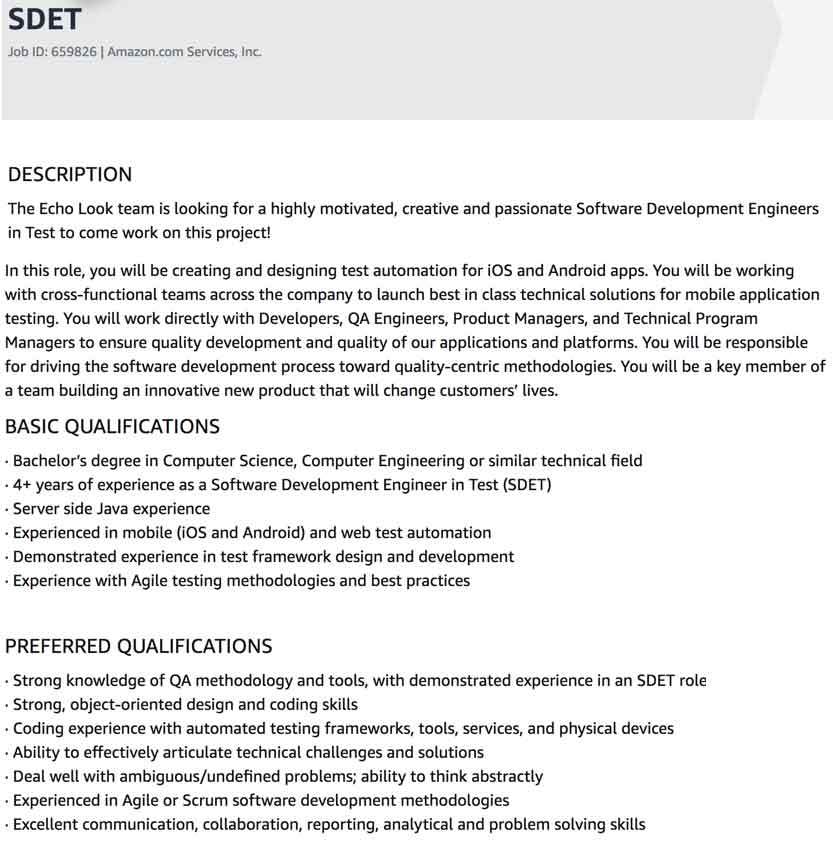
Here is another senior software developer in test position job requirement for a health care company:
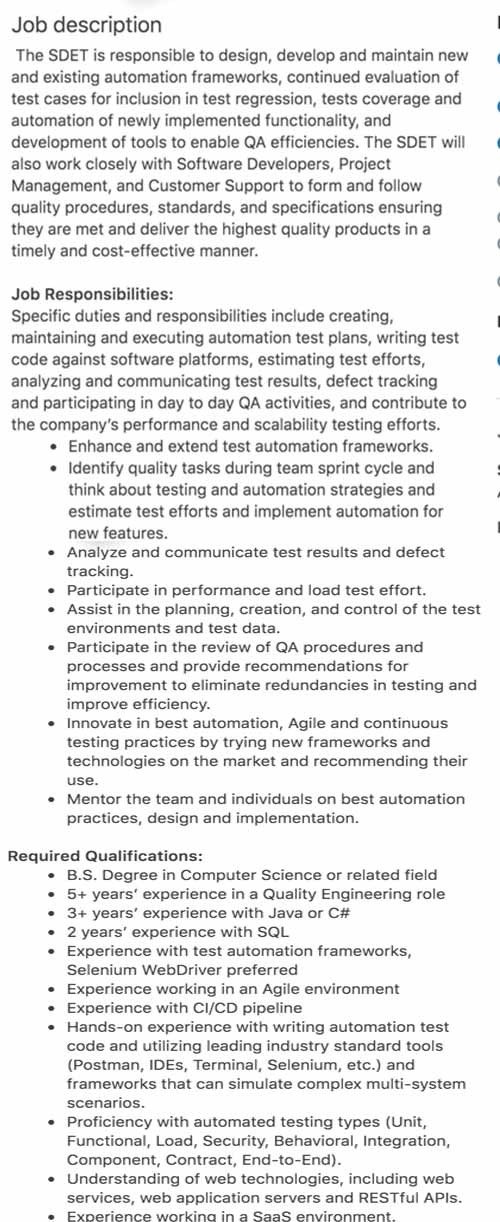
As you can see, both jobs require someone who has both testing and programming skills and can apply them to real-world situations. (Also, notice the emphasis on test automation tools for functional, API, and performance testing.)
If you’re looking for the different levels of software engineers at companies like Microsoft, Google, and Facebook, you can see them on the site Levels.
How do you become an SDET now?
If you’re moving from manual QA or junior automation into an SDET role, don’t try to learn every framework and AI tool at once. Build one small, complete project that shows how you work. Automate a UI or API flow, run it in CI, use realistic test data, write up the risks you covered, and show how you tracked down a failure.
In a TestGuild webinar, Kuzzat Altay compared coding practice to working out. You build fluency through repetition. Learn the testing fundamentals first, then use code to automate the test decisions that matter. That beats collecting tool names or pasting in generated code you can’t explain.
If AI helped you build the project, say so. Explain what it did, what you changed, and how you verified the result. Hiring managers will trust that a lot more than a project that pretends AI wasn’t involved.
For the job search, set alerts for SDET, Software Engineer in Test, QA Automation Engineer, Quality Engineer, and Test Automation Engineer. Then map each posting back to a short skills plan. A missing tool on the list is something to learn, not a reason to skip applying.
SDET salary and career progression
SDETs often earn more than testers in more narrowly scoped roles, because the job asks for software engineering depth, automation ownership, and responsibility for quality systems. The title alone doesn’t set the number, though. Location, level, industry, domain, language stack, cloud and infrastructure scope, and how much you own all move it.
Besides skill differences between the two positions, you’ll also see a significant salary difference.
Here’s how three current U.S. sources compare. Each one measures something different, so don’t treat any of them as “the” SDET salary.
| Source | What it measures | Pay | As of |
|---|---|---|---|
| BLS | Software Quality Assurance Analysts and Testers (a broad occupation that includes manual testers, automation engineers, and SDETs) | $104,300 median annual wage | May 2025 |
| Salary.com | QA Automation Engineer, base salary only | $87,760 average base Middle 50%: $79,864 to $94,857 |
October 1, 2026 |
| Levels.fyi | Quality Assurance Software Engineer, Testing (SDET) specialization, total compensation | $140,633 median Middle 50%: $108,000 to $200,000 90th percentile: $253,000 |
October 1, 2026 |
Books for Wannabee SDET
Even though the book How We Test Software at Microsoft is slightly dated now, they have a nice SDET roadmap example of what Microsoft was using years ago to hire professional SDETs:
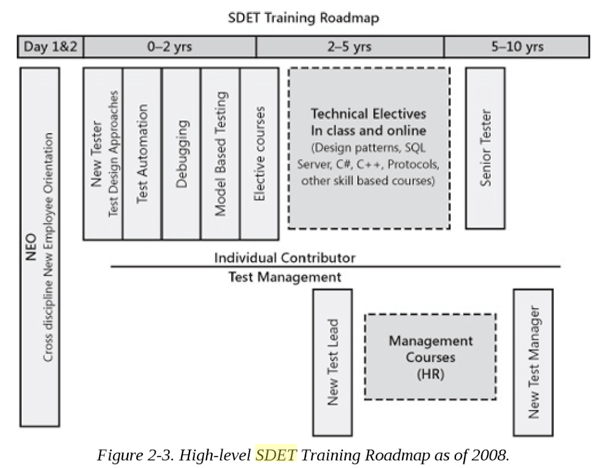
The book How Google Tests Software also contains a bunch of info on The Software Engineer in Test role, including a SET Workflow example.
Change in the Hiring Process for Testers
I’m not sure whether any of you have been on a testing job interview in a while, but that process has also changed.
Such an interview will often be for the role of a development engineer in test, so you get bombarded with programming-related questions.
I’ve heard from a number of folks that have been completely caught off-guard by these types of SDET-like interview questions.
If you haven’t been on a job interview in a long time, you may want to brush up on how to pass an automation testing coding interview before you start applying for a software development engineer position.
I know from my experiences that finding and hiring people with all the required skills can be difficult. So if you like the challenge of testing and enjoy developing code, a career as an SDET might be the perfect choice for you.
SDET FAQ
What is the full form of SDET?
SDET stands for Software Development Engineer in Test. Some companies use close variants such as Software Engineer in Test or Software Developer in Test.
Are companies still hiring SDETs?
Yes, though the work is often posted under other titles. Search for SDET, Software Engineer in Test, QA Automation Engineer, Quality Engineer, and Test Automation Engineer, then compare the actual responsibilities and technical expectations.
What is the difference between an SDET and a QA tester?
A QA tester usually focuses more on exploration, validation, and defect reporting. An SDET is also expected to program, build and maintain automation, improve testability, and work closely with the development pipeline. Strong exploratory testing is valuable in both roles.
What skills do SDETs need now that AI writes tests?
Start with engineering fundamentals: programming, test design, automation, APIs, CI/CD, debugging, and system thinking. Then learn to use AI tools critically for test ideas, test data, failure analysis, and coverage gaps. You still have to verify the output, protect sensitive data, and understand product risk.
Will AI replace SDETs?
Unlikely. AI makes it cheaper to produce code, which means teams produce more of it, and all of it needs testing. AI can speed up test creation and failure analysis, but it doesn’t own release risk or decide whether an output can be trusted. Teams still need people who can design meaningful coverage, investigate odd behavior, and explain tradeoffs.
How can a QA tester move into an SDET role?
Pick one language used in your target jobs, build up your API and automation skills, learn CI/CD basics, and create a small project that shows your code, test design, and debugging process. Apply under several related job titles, not only SDET.
How can you improve your testing skills?

Of course, the key to keeping or obtaining a better job in a technology-based field is always working on your skills. If you are a tester or already an SDET, check out the yearly Automation Guild to make sure you stay up to speed with the latest tips, tools, techniques, and best practices you need to succeed with creating automation testing.

Joe Colantonio is the founder of TestGuild, an industry-leading platform for automation testing and software testing tools. With over 25 years of hands-on experience, he has worked with top enterprise companies, helped develop early test automation tools and frameworks, and runs the largest online automation testing conference, Automation Guild.
Joe is also the author of Automation Awesomeness: 260 Actionable Affirmations To Improve Your QA & Automation Testing Skills and the host of the TestGuild podcast, which he has released weekly since 2014, making it the longest-running podcast dedicated to automation testing. Over the years, he has interviewed top thought leaders in DevOps, AI-driven test automation, and software quality, shaping the conversation in the industry.
With a reach of over 400,000 across his YouTube channel, LinkedIn, email list, and other social channels, Joe’s insights impact thousands of testers and engineers worldwide.
He has worked with some of the top companies in software testing and automation, including Tricentis, Keysight, Applitools, and BrowserStack, as sponsors and partners, helping them connect with the right audience in the automation testing space.
Follow him on LinkedIn or check out more at TestGuild.com.
Related Posts

Short answer: Grok Bot found a real bug, and it stopped about two inches below the surface. I pointed a […]

A Director of Sales hit me with “AI-DLC” last week like I should already know it. I nodded. Then I […]

Your developers are shipping more code than they were a year ago. Probably a lot more. And your test coverage […]

I’ve talked to a lot of people who claim their tool does “agentic testing.” Most of the time it’s a […]