

Amazon EC2 (Elastic Compute Cloud) is an AWS service that provides virtual servers, called instances, for running applications in the cloud. It offers flexible compute resources that can be selected based on workload requirements.
- Provides virtual servers on demand
- Supports different instance families for various workloads
- Offers flexible compute, memory, storage, and networking options
- Supports multiple pricing models such as On-Demand, Savings Plans, Reserved Instances, and Spot Instances
- Allows instances to be selected based on application requirements
EC2 Instance Naming convention
Instance type names like "m6a.4xlarge" follow a logical pattern. Breaking down "m6a.4xlarge":
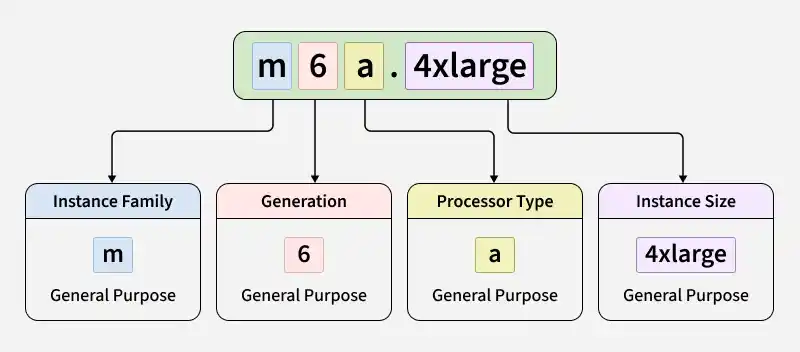
| Part | Meaning | Example |
|---|---|---|
| m | Instance Family | General Purpose |
| 6 | Generation | 6th generation |
| a | Processor Type | AMD |
| 4xlarge | Instance Size | Defines vCPU, memory, and networking capacity |
EC2 Instance Type Categories
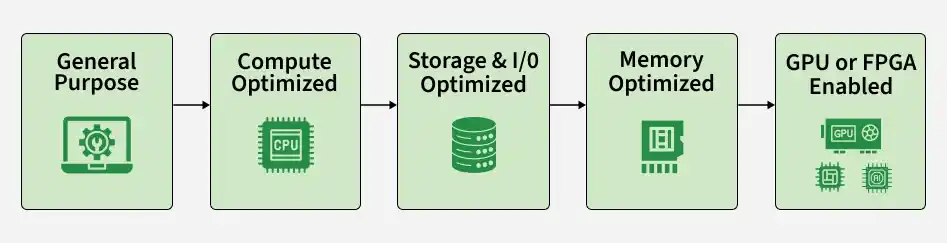
AWS groups EC2 instances into several families based on target use cases.
1. General Purpose Instances
It provide a balanced mix of compute, memory, and networking, suitable for workloads that don't require specialized hardware but need reliable overall performance.
- Balanced CPU, memory, and network capabilities.
- Versatile across many different workload types.
- Cost-effective for common, everyday use cases.
Families
- M Series (e.g., M7g, M6i, M5): Balanced resources for small to medium databases, enterprise applications, and web servers. Newer generations like M7g (Graviton3) offer improved price-performance.
- T Series (e.g., T4g, T3, T2): Burstable Performance Instances that provide a baseline CPU level with the ability to burst above it using CPU credits. Ideal for variable or low-to-moderate CPU workloads such as microservices, CI/CD pipelines, and small web servers.
- A1 Series: ARM-based instances powered by AWS Graviton processors, offering strong price-performance for scale-out and ARM-compatible workloads.
- Mac Series: Mac mini hardware used as EC2 instances, designed for macOS development and testing.
Use Cases
- Hosting web servers and scalable web applications.
- Building, testing, and deploying applications in development environments.
- Hosting content delivery networks (CDNs) with low latency and high throughput.
2. Compute Optimized Instances
It designed for tasks that require significant processing power, prioritizing CPU performance over memory.
- High CPU-to-memory ratio.
- Optimized for compute-intensive, parallelizable workloads.
- Graviton-powered variants (e.g., C7g) offer significant price-performance improvements.
Use Cases
- Batch processing and high-performance web servers.
- Scientific modeling and media transcoding.
- Machine learning inference and dedicated gaming servers.
Families
- C Series (e.g., C7g, C6i, C5): The primary compute-optimized family, covering batch processing, high-performance web servers, scientific modeling, media transcoding, gaming servers, and ML inference.
3. Memory Optimized Instances
It deliver a large amount of RAM relative to CPU, designed for applications that process large datasets entirely in memory.
- High memory capacity with fast access and low latency.
- Enhanced networking and storage support.
- Suited for workloads where RAM is the primary bottleneck.
Use Cases
- High-performance relational and NoSQL databases.
- Big data analytics (Apache Spark, Hadoop).
- Real-time data streaming and in-memory caches (Redis, Memcached).
Families
- R Series (e.g., R8g, R7g, R6g, R5): Best for in-memory databases like SAP HANA, large in-memory caches, big data analytics, and enterprise applications requiring substantial RAM.
- X Series (e.g., X2gd, X1e): Extremely high memory capacity for very large-scale enterprise workloads.
- Z1d Series: Combines high compute with high memory, suited for Electronic Design Automation (EDA) and relational databases requiring both.
4. Storage Optimized Instances
It deliver high-throughput, low-latency local storage, designed for workloads with heavy read/write access to large datasets.
- High-speed, low-latency local NVMe SSDs.
- Optimized for large sequential I/O operations.
- Enhanced networking for fast data transfer.
Use Cases
- Data warehousing and big data analytics.
- High-frequency OLTP (Online Transaction Processing).
- Distributed file systems and log or data processing applications.
Families
- I Series (e.g., I4i, I3en, I3): Optimized for low-latency, high-IOPS transactional workloads including NoSQL databases (Cassandra, MongoDB) and real-time analytics.
- D Series (e.g., D3en, D2): High-density HDD storage for distributed file systems (HDFS), large-scale parallel processing (MapReduce), and log processing.
- H1 Series: High disk throughput for large-scale data processing and distributed file systems.
5. Accelerated Computing Instances
It include specialized hardware such as GPUs or FPGAs to perform specific tasks far faster than standard CPUs.
- Equipped with NVIDIA GPUs, AWS Inferentia, AWS Trainium, or FPGAs.
- High parallel processing power.
- Optimized for compute-intensive and graphics-heavy tasks.
Use Cases
- Machine learning training and inference.
- Video rendering and transcoding.
- Scientific simulations and financial risk analysis (HPC).
Families
- P Series (e.g., P5, P4d, P3): NVIDIA GPU-equipped instances primarily for machine learning training, deep learning, and HPC.
- G Series (e.g., G6, G5, G4dn): NVIDIA GPU instances for graphics-intensive applications (3D rendering, video encoding, virtual workstations), ML inference, and game streaming.
- Inf / Trn Series (e.g., Inf2, Trn1): Feature AWS Inferentia and Trainium chips, purpose-built for high-performance ML inference and training at scale.
- F1 Series: Use FPGAs for custom hardware acceleration in genomics, financial modeling, and real-time video processing.
Choosing an Instance Type
- Start with General Purpose: Begin with an M or T family instance for balanced compute and memory needs.
- Monitor with CloudWatch: Track CPU, memory, and EBS I/O under real workloads to identify performance bottlenecks.
- Choose the Right Family: Move to Compute Optimized (C) for CPU-heavy workloads, Memory Optimized (R) for memory-intensive workloads, or Storage Optimized (I) when storage I/O is the bottleneck.
EC2 Pricing Models
Choosing an instance type is a separate decision from choosing how you pay for it.
- On-Demand: Pay by the second with no commitment. Best for unpredictable workloads and development or testing.
- Savings Plans / Reserved Instances: Commit to a 1 or 3 year term for discounts of up to 72%. Best for steady-state, predictable workloads.
- Spot Instances: Bid on spare EC2 capacity for discounts of up to 90%. Ideal for fault-tolerant, interruption-tolerant workloads like batch processing or data analysis, as AWS can terminate these instances with a two-minute warning.
Note: You can estimate costs across all pricing models using the AWS Pricing Calculator.