

In Java, classes and interfaces are fundamental components used to design and organize programs. A class represents objects by defining their data and operations, whereas an interface specifies a contract for implementing common behavior. Choosing between them depends on how the functionality needs to be defined and shared.
- Classes support object creation, constructors, and state management.
- Interfaces promote abstraction and allow a class to implement multiple behavioral contracts.
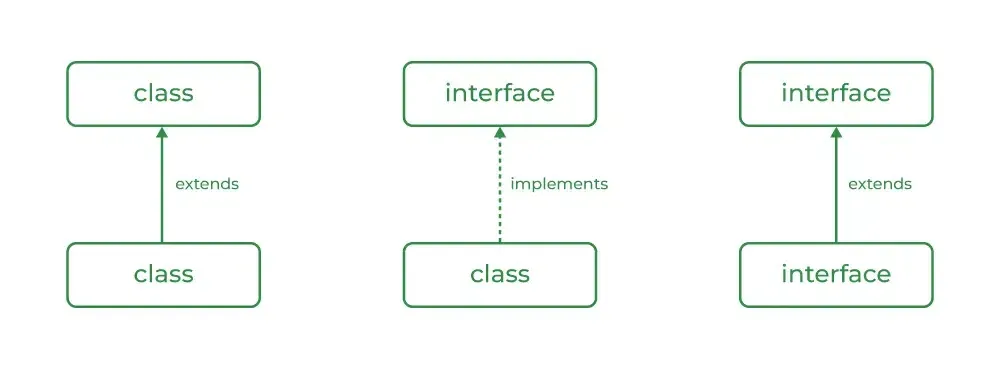
A class can extend another class and implement an interface, while an interface can only extend another interface, not implement a class.
Class
A class is a blueprint for creating objects. It encapsulates fields (state) and methods (behavior) that are common to all objects of that type.
class Student{

    //data member (also instance variable)
    int id;

    //data member (also instance variable)
    String name;

    public static void main(String args[]){

        //creating an object of Student
        Student s1=new Student();
        System.out.println(s1.id);
        System.out.println(s1.name);
    }
}
Output
0
null
Explanation: Above code defines a Student class with two instance variables, id and name, and creates an object to demonstrate default values. It shows that objects of a class can hold state and access its fields.
Interface
An interface in Java defines a contract that classes can implement to provide specific behavior. Interface variables are implicitly public, static, and final, while abstract methods are implicitly public and abstract. Since Java 8, interfaces can also contain default and static methods, and since Java 9, they can contain private methods.
import java.io.*;

// Interface Declared
interface testInterface{

    // public, static and final
    final int a = 10;

    // public and abstract
    void display();
}

// Class implementing interface
class TestClass implements testInterface{

    // Implementing the capabilities of Interface
    public void display(){
      System.out.println("Geek");
    }
}

class Geeks{

    public static void main(String[] args){

        TestClass t = new TestClass();
        t.display();
        System.out.println(t.a);
    }
}
Output
Geek
10
Explanation: Above code defines an interface with a constant and an abstract method, then implements it in a class providing method behavior. It demonstrates how a class can adopt an interface and use its constants and methods.
Class vs Interface
The following table lists all the major differences between an interface and a class in Java.
Features | Class | Interface |
|---|---|---|
Keyword | The keyword used to create a class is "class". | The keyword used to create an interface is "interface". |
Instantiation | A class can be instantiated, i.e., objects of a class can be created. | An interface cannot be instantiated directly, instead, it is implemented by a class or a struct. |
Inheritance | Classes do not support multiple inheritance. | Interface supports multiple inheritance. |
Inheritance Mechanism | A class can inherit another class using the keyword extends. | A class uses implements to adopt an interface, while an interface uses extends to inherit another interface. |
Constructors | It can contain constructors. | It cannot contain constructors. |
Methods | Methods in a class can be abstract, concrete, or both. | An interface contains abstract methods by default (before Java 8) or default/static methods (from Java 8 onward). |
Access Specifiers | Variables and methods in a class can be declared using any access specifier(public, private, default, protected). | Interface variables are public static final, and methods are public by default. |
Variables | Variables in a class can be static, final, or neither. | All variables are static and final. |
Purpose | A class is a blueprint for creating objects and encapsulates data and behaviour. | An interface specifies a contract for classes to implement by focusing on capabilities rather than implementation. |