Log inSign up
Log inSign up
HackSoc
575 posts
@HackSoc

HackSoc

@HackSoc
This account is no longer used. Please see our current media on our website at: hacksoc.org.
hacksoc.org
Joined August 2013
80 Following
341 Followers
RepliesRepliesRepostsRepostsMediaMedia

Log in or sign up for X

See what’s happening and join the conversation

Continue with phone
or
Log in with username or email
Terms·Privacy·Cookies·Accessibility·US TIDA·Ads Info·© 2026 X Corp.
  • @HackSoc
    HackSoc
    @HackSoc
    Aug 18, 2022
    Congratulations to everyone who just got into #UniOfYork! 💜 If you would be interested in joining the Computer Science society, whether or not that's your degree, you can join our Discord to talk to other students! discord.gg/VAZ95TgR8X #AlevelResultsDay2022 #alevels2022
    discord.com
    Join the HackSoc Discord Server!
    Official chat platform for HackSoc, the Computer Science Society, at the University of York. | 538 members
  • @HackSoc
    HackSoc
    @HackSoc
    Mar 10, 2022
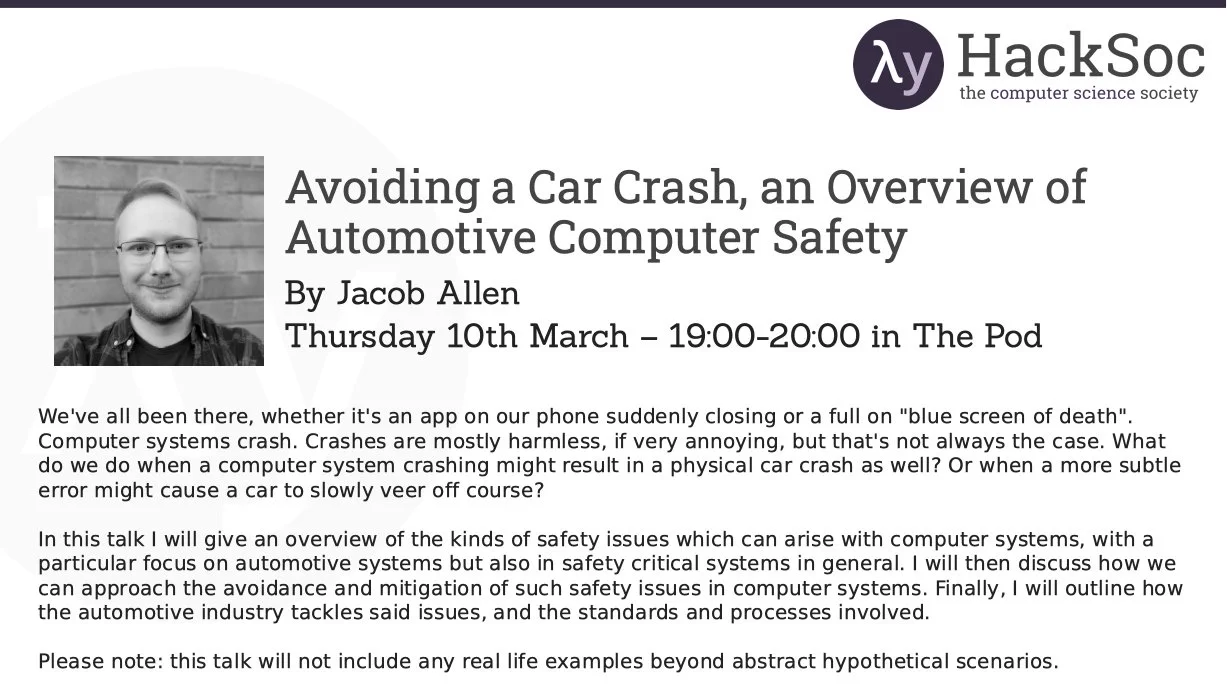
    Join us tonight in CSE/082&083 (The Pod) at 19:00 for an in person talk: "Avoiding a Car Crash, an Overview of Automotive Computer Safety" by Jacob Allen!
    Picture of the speaker, accompanied by the text in the tweet, and: 
Talk Description: We've all been there, whether it's an app on our phone suddenly closing or a full on "blue screen of death". Computer systems crash. Crashes are mostly harmless, if very annoying, but that's not always the case. What do we do when a computer system crashing might result in a physical car crash as well? Or when a more subtle error might cause a car to slowly veer off course?

In this talk I will give an overview of the kinds of safety issues which can arise with computer systems, with a particular focus on automotive systems but also in safety critical systems in general. I will then discuss how we can approach the avoidance and mitigation of such safety issues in computer systems. Finally, I will outline how the automotive industry tackles said issues, and the standards and processes involved.

Please note: this talk will not include any real life examples beyond abstract hypothetical scenarios.
  • @HackSoc
    HackSoc
    @HackSoc
    Feb 24, 2022
    Join us tonight in CSE/082&083 (The Pod) at 7PM for an in person talk: "An Introduction to Reservoir Computing, or Why I’m Doing a PhD in Magic" by C Wringe!
    A picture of the talk's speaker, accompanied by the text:
An Introduction to Reservoir Computing, or Why I’m Doing a PhD in Magic, by C Wringe
19:00–20:00 Thursday 24 February 2022
CSE/082&083
Unconventional Computing is a field in Computer Science that attempts to look at new ways of performing computation, and on a larger level, what “performing computation” even means. It can be approached from two directions: unconventional models, which looks at using models other than Turing Machines and Grammars, and unconventional materials, which looks at performing computation on any material that isn’t silicon.

Reservoir computing is sort of both. It takes the dynamics of any given substance, and uses that to perform computations.

In this talk, I’ll introduce the models behind Reservoir Computing, some physical instantiations of it, and then I’ll elaborate on the different ways it gets used in the literature.
  • @HackSoc
    HackSoc
    @HackSoc
    Feb 3, 2022
    Join us at 7PM GMT this evening for a virtual talk: "The History of Calculators" by Aaron Christiansen! The video will premiere at youtube.com/watch?v=fb53nr…
    A picture of the talk's speaker, accompanied by the text:
Talk: The History of Calculators by Aaron Christiansen
19:00–20:00 Thursday 3 February 2022
Online - HackSoc YouTube, Q&A in Discord
Ever since picking up my first scientific Casio for GCSEs, I've had a strange fascination with calculators. Even in today's smartphone-dominated world, these single-purpose devices still hold an important place, especially in education. As one of the earliest forms of a crude pocket computer, they also have a rich history - which I'll cover in this talk! From the earliest mechanical models, to early vacuum-florescent display pocket calculators, and up to the present day, we'll explore notable models and advances made along the way to modern readily-available devices stuffed with extra features.
  • @HackSoc
    HackSoc
    @HackSoc
    Dec 19, 2021
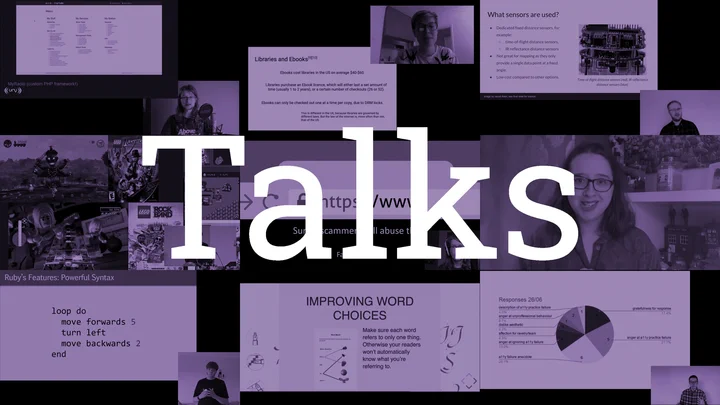
    Second term talk submissions are open, and if you'd like to do a talk next term, submit one at this Google Form: forms.gle/HSxWLTyYdS7wNb… Talks can be about anything you are passionate about - not just Computer Science! Submissions are closing on the 31st of December.
    A background collage of previous talks, with the text "Talks" overlayed.