With Latest Update, Alexa Refuses To Pass The Aux

Although the feature has been deleted from newer models, there was a time when Amazon’s Echo devices included a 3.5 mm “aux” input jack that let you connect other audio sources to the smart speaker. Alexa would even let you switch over to an external source with a voice command — or at least, it used to.

As first reported by Reddit user [n8-sd], Amazon has started informing users that voice control over the 3.5 mm jack is no longer supported. While the physical input will still function on models equipped with it, if you want to mute the audio coming from an external device you’ll have to wade through the Alexa smartphone application to do it.

In a statement to Ars Technica, an Amazon rep confirmed that voice control over the auxiliary input has been removed as of the latest software version, and that their analytics showed not many people were using the feature in the first place. They also pointed out that no changes have been made to voice control of Bluetooth devices. While we don’t doubt that the total number of users that were physically plugging an audio source into their Echos was probably low in the grand scheme of things, that doesn’t really explain why such a simple feature needed to be actively removed.

Some commenters have theorized that the real reason behind the change is the fact that Amazon has no way of monitoring what users are playing over the auxiliary input. Since cataloging and selling the media consumption habits of users is big business these days, that’s a problem. While they might prefer to disable the feature entirely, they know that would stir up some bad press, so they’re opting to simply make it more annoying to use. We’re not saying we entirely buy this explanation, but it’s not the craziest thing we’ve ever heard either.

Although the Echo devices have never been particularly hackable, they have enjoyed a certain amount of success with tech-savvy users, making it all the more disappointing to see the ecosystem seemingly becoming less capable over time.

70 DIY Synths On One Webpage

If you want to dip your toes into the deep, deep water of synth DIY but don’t know where to start, [Atarity] has just the resource for you. He’s compiled a list of 70 wonderful DIY synth and noise-making projects and put them all in one place. And as connoisseurs of the bleepy-bloopy ourselves, we can vouch for his choices here.

The collection runs the gamut from [Ray Wilson]’s “Music From Outer Space” analog oddities, through faithful recreations like Adafruit’s XOXBOX, and on to more modern synths powered by simple microcontrollers or even entire embedded Linux devices. Alongside the links to the original projects, there is also an estimate of the difficulty level, and a handy demo video for every example we tried out.

Our only self-serving complaint is that it’s a little bit light on the Logic Noise / CMOS-abuse side of synth hacking, but there are tons of other non-traditional noisemakers, sound manglers, and a good dose of musically useful devices here. Pick one, and get to work!

Measuring A Well With Just A Hammer And A Smartphone

What’s the best way to measure the depth of a well using a smartphone? If you’re fed up with social media, you might kill two birds with one stone and drop the thing down the well and listen for the splash. But if you’re looking for a less intrusive — not to mention less expensive — method, you could also use your phone to get the depth acoustically.

This is a quick hack that [Practical Engineering Solutions] came up with to measure the distance to the surface of the water in a residential well, which we were skeptical would work with any precision due to its deceptive simplicity. All you need to do is start a sound recorder app and place the phone on the well cover. A few taps on the casing of the well with a hammer send sound impulses down the well; the reflections from the water show up in the recording, which can be analyzed in Audacity or some similar sound editing program. From there it’s easy to measure how long it took for the echo to return and calculate the distance to the water. In the video below, he was able to get within 3% of the physically measured depth — pretty impressive.

Of course, a few caveats apply. It’s important to use a dead-blow hammer to avoid ringing the steel well casing, which would muddle the return signal. You also might want to physically couple the phone to the well cap so it doesn’t bounce around too much; in the video it’s suggested a few bags filled with sand as ballast could be used to keep the phone in place. You also might get unwanted reflections from down-hole equipment such as the drop pipe or wires leading to the submersible pump.

Sources of error aside, this is a clever idea for a quick measurement that has the benefit of not needing to open the well. It’s also another clever use of Audacity to use sound to see the world around us in a different way.

Continue reading “Measuring A Well With Just A Hammer And A Smartphone” →

A More Conspicuous Computer Assistant

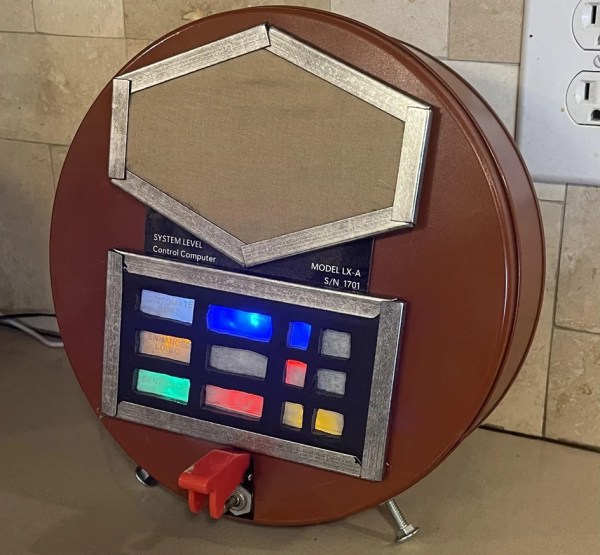
Back in the last century, especially in the ’40s to the ’60s, one of the major home decor trends was to install various home appliances, like the television or stereo, into its own piece of furniture. These were usually bulky, awkward, and incredibly heavy. And, since real life inspires art, most of the futuristic sci-fi technology we saw in movies and TV of the time was similarly conspicuous and physical. Not so with modern technology, though, where the trend now is to hide it out of the way and forget it exists. But [dermbrian] wanted some of his modern technology to have some of the mid-century visibility aesthetic so he made some modifications to his Amazon Echo.

The Echo itself remains largely unmodified, other than placing it inside a much larger cookie tin with some supporting electronics. For that, [dermbrian] found a relay board with a built-in microphone which switches the relay off when it detects sound so that when the Echo is activated, the sound from its speaker activates the module. From there it drives a series of blinkenlights which mimic the 60s computer aesthetic. Some custom fabrication and light diffusion methods were needed to get it to look just right, and a switch on the outside can disable the mechanism if it is getting triggered by background noise like music from his stereo.

While the appeal of this style may be lost on anyone who wasn’t a fan of the original Lost in Space, Star Trek, or Jetsons, it certainly holds a special significance for those who grew up in that era. It’s certainly not the first project we’ve seen to take a look back at the aesthetics of bygone eras, either. Take a look at this project which adds lenses to modern displays to give them the impression of antiquated CRT displays.

Continue reading “A More Conspicuous Computer Assistant” →

Photo of the Echo Dot PCB, highlighting the capacitor that needs to be shorted out for the exploit to work

Squeezing Secrets Out Of An Amazon Echo Dot

As we have seen time and time again, not every device stores our sensitive data in a respectful manner. Some of them send our personal data out to third parties, even! Today’s case is not a mythical one, however — it’s a jellybean Amazon Echo Dot, and [Daniel B] shows how to make it spill your WiFi secrets with a bit of a hardware nudge.

There’s been exploits for Amazon devices with the same CPU, so to save time, [Daniel] started by porting an old Amazon Fire exploit to the Echo Dot. This exploit requires tactically applying a piece of tin foil to a capacitor on the flash chip power rail, and it forces the Echo to surrender the contents of its entire filesystem, ripe for analysis. Immediately, [Daniel] found out that the Echo keeps your WiFi passwords in plain text, as well as API keys to some of the Amazon-tied services.

Found an old Echo Dot at a garage sale or on eBay? There might just be a WiFi password and a few API keys ripe for the taking, and who knows what other kinds of data it might hold. From Amazon service authentication keys to voice recognition models and maybe even voice recordings, it sounds like getting an Echo to spill your secrets isn’t all that hard.

We’ve seen an Echo hijacked into an always-on microphone before, also through physical access in the same vein, so perhaps we all should take care to keep our Echoes in a secure spot. Luckily, adding a hardware mute switch to Amazon’s popular surveillance device isn’t all that hard. Though that won’t keep your burned out smart bulbs from leaking your WiFi credentials.

Making A Tape Echo The Traditional Way

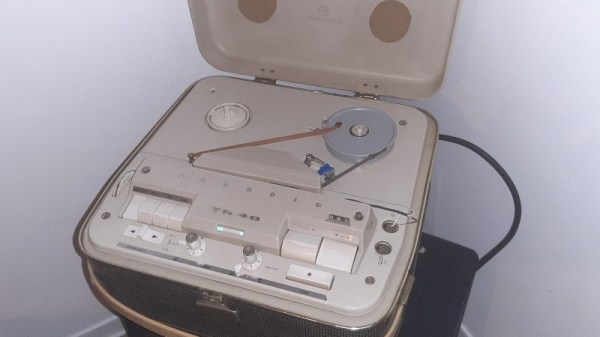
[Juan Nicola] has taken inspiration from the musician hackers of old and re-purposed a reel-to-reel tape recorder into a tape-echo for his guitar with a built-in valve amplifier (video in Spanish).

The principle is to record the sound of the guitar onto a piece of moving magnetic tape, then to read it back again a short time later.  This signal is mixed with the live input and re-recorded back onto the tape further back.  The effect is heard as an echo, and this approach was very popular before digital effects became readily available.

[Juan] installed a new read-head onto his Grundig TK40 and managed to find a suitable mechanical arrangement to keep it all in place.  He has since updated the project by moving to a tape loop, allowing an infinite play-time by re-using the same piece of tape over and over.

Turning tape machines into echo effects is not a new idea, and we’ve shown a few of them over the years, but every one is slightly different!

Both versions are shown after the break.  YouTube closed-caption auto-translate might come in handy here for non-Spanish speakers.

Continue reading “Making A Tape Echo The Traditional Way” →

Sound And Light Play Off Acrylic And Wire In This Engaging Circuit Sculpture

It’s no secret that we really like circuit sculptures around here, and we never tire of seeing what creative ways people come up with to celebrate the components used to make a project, rather than locking them away in an enclosure. And a circuit sculpture that incorporates sound and light in its design is always a real treat to discover.

Called “cwymriad” by its designer, [Eirik Brandal], this sound sculpture incorporates all kinds of beautiful elements. The framework is made from thick pieces of acrylic, set at interesting angles to each other and in contrasting colors. The sound-generating circuit, which uses square wave outputs from an ESP32 to provide carrier and modulation signals for a dual ring modulator, is built on a framework of tinned wires. The sounds the sculpture makes have a lovely resonance to them, like random bells and chimes that fade and mix together. There’s also a matrix of white LEDs that form a sort of digital oscilloscope that displays shifting waveforms in time with the music.

While we like the way this looks and sounds, the real bonus here is the details of construction in the video below. [Eirik]’s careful craftsmanship working with multiple materials is evident throughout; we were especially impressed by the work needed to drill holes for the LED matrix, any one of which slightly out of place would have been painfully obvious in the finished product.

This is far from [Eirik]’s first appearance on these pages. His vacuum tube and silicon “ioalieia” was featured just a few weeks back, and “ddrysfeöd” used the acrylic parts as light pipes in a lovely way.

Continue reading “Sound And Light Play Off Acrylic And Wire In This Engaging Circuit Sculpture” →