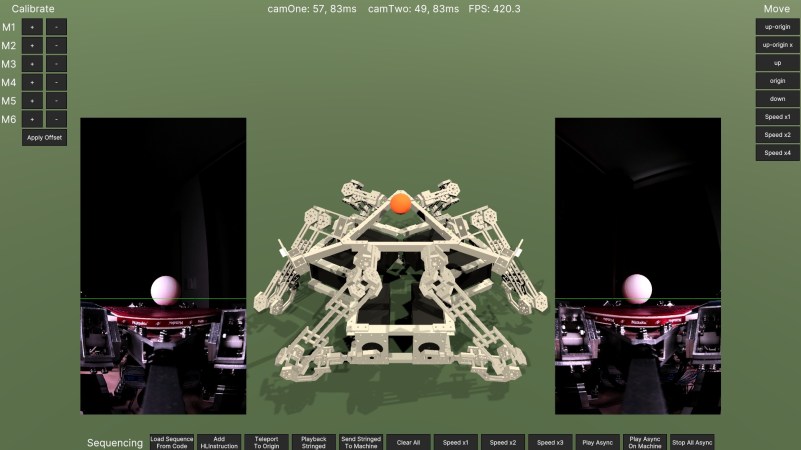
Sometimes, you want to build a simple project– the minimum viable product that solves your problem and nothing else. Other times you might be feeling a little extra, and want to use oodles of machined aluminum, six steppers, two cameras, a Teensy and a PC with a GPU just to bounce a ball. That’s the mood behind [T-Kuhn]’s hexa-bouncer, a Stewart Platform on steroids. You can read all about it on his blog or witness it in action in the video below. Trust us, really have to see it in action.
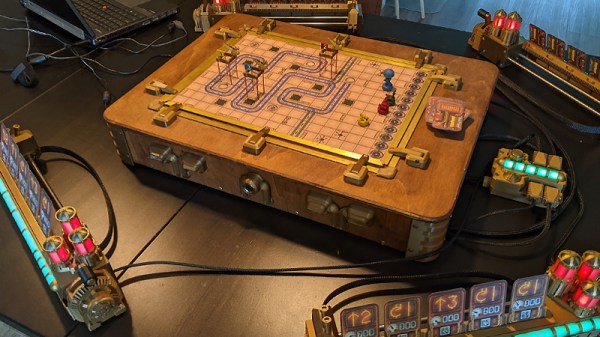
Inspired by the classic game Robo Rally, [Ytec3D]’s Clockwork Derby takes tabletop gaming to the next level by combining steampunk aesthetics with automation. We recently had the chance to see it live at Hackfest, together with [Ytec3D]’s animatronic tentacle, and we can say that his new take on playful robotics offers a unique experience for game enthusiasts. The 300×420 mm board uses magnets, motors, and card readers to handle up to eight players, creating a smooth, automated version of Robo Rally where players can focus on strategy while the board handles movement.
In Clockwork Derby, game pieces are moved by a magnetic system controlled by the board, which rotates and shifts pieces in real-time. Each player uses a card reader to program moves, with up to five cards per round. The board scans these cards via barcode scanners, so you don’t have to worry about tracking your moves or adjusting game pieces manually. [Ytec3D]’s game rules have been optimized for the automated setup, allowing for smoother gameplay and an emphasis on strategic choices.
The project is a standout for hackers and tinkerers who appreciate blending physical mechanics with digital precision. It’s a great example of how classic games can be modernized with a bit of ingenuity and tech. For those interested in DIY gaming projects or automation, Clockwork Derby is definitely worth exploring. To dive deeper into the build details and see more of the project, visit [Ytec3D]’s project page for an in-person look at this inventive tabletop game!
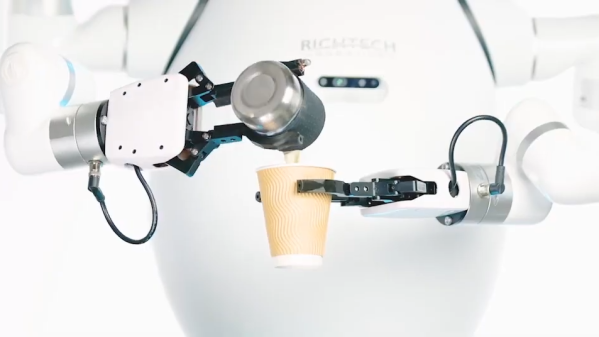
Robots are cool. Everyone knows it, and [Eater NY] highlights a coffee shop with a robotic server opening in Brooklyn. While robots able to prepare and serve drinks or food is not new, it isn’t every day a brick-and-mortar café with a robot behind the counter opens up. But expensive automation isn’t the only puzzle piece needed to make a location work.
A robotic coffee shop (like a robotic burger joint) certainly offers novelty, but can it sustain itself beyond that?
As one example, the linked article above points out that the city of New York prohibits entirely cashless businesses. Establishments must accept cash payments, and it’s unclear how the touchscreen-driven system would comply with that requirement.
There are also many tasks involved in running even a modest establishment — loading, cleaning, and maintaining for example — that can’t be realistically taken care of by an immobile robot barista. It’s unclear to what extent the robotic coffee shop will employ human staff, but it’s clear that human involvement is something that isn’t going be eliminated any time soon.
Some of you may remember the robotic burger joint that our own Brian Benchoff managed to check out, and many of his same observations come to mind. The robot burger was perhaps ahead of its time (its single location is listed as closed on Google maps with no recent activity) but maybe the robot coffee place can make it work.
Still, expensive automation is only one piece of a system, and the ability to crank out a drink per minute 24/7 might not actually be the missing link.
[Christopher Helmke] is doing fantastic work in DIY systems for handling small hardware like fasteners, and that includes robotic placement of hardware into 3D prints. Usually this means dropping nuts into parts in mid-print so that the hardware is captive, but that’s not really the story here.
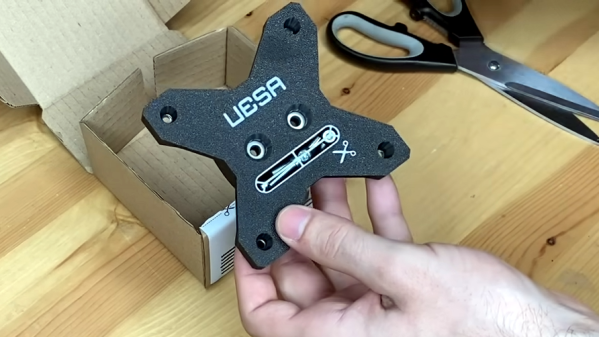
The really inventive part we want to highlight is the concept of reducing packaging and labor. Instead of including a zip-lock bag of a few bolts, how about embedding the bolts into a void in the 3D print, covered with a little snip-out retainer? Skip ahead to 1:54 in the video to see exactly what we mean. It’s a pretty compelling concept that we hope sparks a few ideas in others.
As clever as that concept is, the rest of the video is also worth a watch because [Christopher] shows off a DIY system that sits on top of his 3D printer and takes care of robotically placing the hardware in mid-print. He talks all about the challenges of such a system. It’s not perfect (yet), but seeing it in action is very cool.
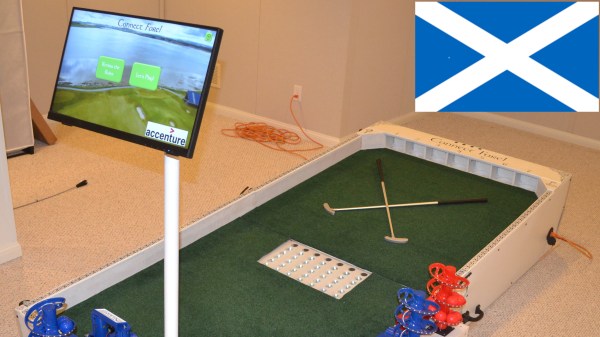
We’ve just come across [Bithead]’s amazing, robotically-automated mashup of miniature golf and Connect Four, which also includes an AI opponent who pulls no punches in its drive to win. Connect Fore! celebrates Scotland — the birthplace of golf, after all — and looks absolutely fantastic.
Scotty the AI opponent uses this robotic turret to make their moves in a game of Connect Fore!
The way it works is this: players take turns putting colored balls into one of seven different holes at the far end of the table. Each hole feeds to a clear tube — visible in the middle of the table — which represent each of the columns in a game of Connect Four.
Each player attempts to stack balls in such a way that they create an unbroken line of four in their color, either horizontally, vertically, or diagonally. In a one-player game, a human player faces off against “Scotty”, the computer program that chooses its moves with intelligence and fires balls from a robotic turret.
[Bithead] started this project as a learning experience, and being such a complex project, the write-up is extensive. We really recommend reading through the whole thing if you are at all interested in what goes into making such a project work.
What’s particularly interesting is all of the ways in which things nearly worked, or needed nudging or fine adjustment. One might think that reliably getting a ball to enter a hole and roll down a PVC tube wouldn’t be a particularly finicky task, but it turns out that all kinds of things can go wrong.
Even finding the right play surface was a challenge. [Bithead]’s first purchase from Amazon was a total waste: it looked bad, smelled bad, and balls didn’t roll well on it. There are high-quality artificial turfs out there, but the good stuff gets shockingly expensive, and such a small project pretty much pigeonholes one as a nuisance customer when it comes to vendors. The challenges [Bithead] overcame serve as a reminder to keep the 80/20 rule (or Pareto principle) in mind when estimating what will get a project to the finish line.
Right under the page break below is a brief video tour of the completed table, and after that, you can watch a game in action as [Bithead] faces off against Scotty the AI. Curious about the inner workings? The last video has some build details that fill in a few blanks from the write-up.
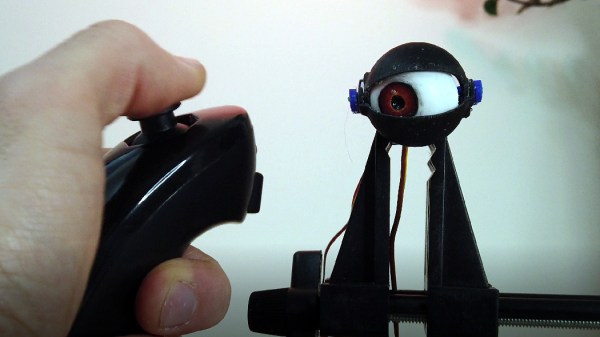
[Enza3D] shows off a surprisingly compact articulated animatronic eyeball that can be intuitively controlled with a Wii nunchuk controller. The design uses 3D printed parts and some tiny servos, and all of the necessary electronics can be easily purchased online. The mechanical design of the eye is very impressive, and [Enza3D] walks through several different versions of the design, the end result of which is a tidy little assembly that would fit nicely into masks, costumes, or other projects.
A Wii nunchuk is ideal for manual control of such a device, thanks to its ergonomic design and ease of interface (the nunchuk communicates over I2C, which is easily within the reach of even most modest of microcontrollers.) Of course, since driving servos is also almost trivial nowadays, it doesn’t look like working this into an automated project would pose much of a challenge.
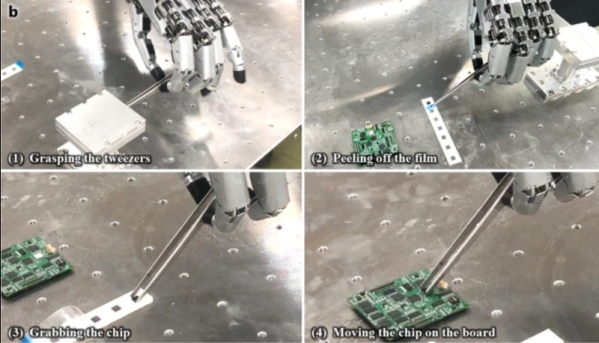
Korean researchers have created a very realistic and capable robot hand that looks very promising. It is strong (34N of grip strength) and reasonably lightweight (1.1 kg), too. There are several videos of the hand in action, of which you can see two of them below including one where the hand uses scissors to cut some paper. You can also read the full paper for details.