
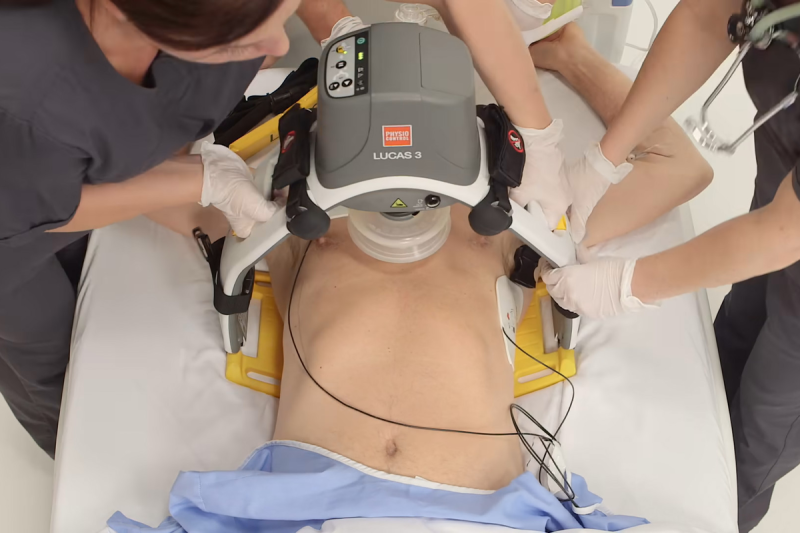
Usually in Tech In Plain Sight, we talk about technology you probably see every day, even if you don’t notice it. But we hope you don’t get to see one of the latest crop of medical robots, such as the LUCAS chest compression system. If you watch the popular TV series “The Pitt”, though, you may have caught a glimpse of one of these medical marvels. They aren’t fiction. They are very real devices.
Calling them robots might be stretching the definition a little. They don’t roam the halls looking for patients. But once attached to someone in cardiac arrest, they can take over one of the most important — and physically demanding — parts of CPR: chest compressions.
Keep The Blood Moving
When someone’s heart stops pumping blood, time is critical. CPR doesn’t normally restart the heart on its own. Instead, chest compressions produce enough blood flow to keep oxygen reaching the brain and heart while rescuers work on the underlying problem and, when appropriate, use a defibrillator.
Doing that well is harder than it looks on television. Current American Heart Association guidelines call for adult chest compressions 100 to 120 times per minute, at least 5 cm deep but generally no deeper than 6 cm, while allowing the chest to recoil fully between compressions. Interruptions should be kept to a minimum.
That’s hard physical work. In fact, studies show compression depth begins to fall after only about 90 to 120 seconds, which is one reason CPR teams normally swap compressors every two minutes. But a robot doesn’t get tired.
Meet LUCAS
LUCAS stands for Lund University Cardiopulmonary Assist System, reflecting the device’s origins in Lund, Sweden. Early versions entered clinical use around 2002-2003 and were pneumatically powered. Later versions replaced the compressed-gas system with an electric motor and battery.
The current LUCAS 3 looks something like a small drill press straddling the patient as you can see in the video below. A backplate goes beneath the torso, and a frame locks onto it. An electrically driven piston presses a suction-cup-like pad against the sternum. Internally, the motor drives a belt and ball screw that moves the piston up and down.
Factory settings are around 102 compressions per minute and roughly 53 mm compression depth for a typical adult, although parameters can be configured.
Beyond tirelessness, another obvious advantage is that LUCAS doesn’t need hands. Medics can deal with ventilation, drugs, defibrillation, IV access, and the dozens of other things occurring during a cardiac arrest. More importantly, the device can keep compressing while a patient is being carried, wheeled through corridors, or transported in an ambulance — situations where doing good manual CPR is awkward and sometimes dangerous to the practitioner.
So Does It Save More People?
You might reasonably expect perfectly regular machine CPR to beat a tired human. Large randomized trials haven’t demonstrated that, however. The 4,471-patient PARAMEDIC trial found 30-day survival of 6.3% with LUCAS versus 6.8% with manual CPR, not a statistically significant difference. The 2,589-patient LINC trial similarly found essentially identical four-hour survival — 23.6% versus 23.7% — and no significant improvement in longer-term neurological outcomes.
That doesn’t make the machines useless. It says something slightly different: high-quality mechanical CPR hasn’t proven superior to high-quality manual CPR as a routine replacement. The International Liaison Committee on Resuscitation currently recommends against routine mechanical CPR, while specifically noting that it can be a reasonable alternative when sustained manual compressions are impractical or would endanger the practitioner.
One issue is setup. Installing the machine adds a time penalty: compressions must stop briefly while the backplate and mechanism are positioned. Good training is essential to keep that interruption short. Another problem is that some studies show potential links to higher rates of internal chest injuries, such as bleeding around the lungs. There have also been rare device malfunctions or power failures that can compromise care.
Not The Only Game In Town
LUCAS isn’t alone. ZOLL’s AutoPulse takes a very different mechanical approach. Instead of a piston pushing on one spot, a motor tightens a broad load-distributing band around the patient’s chest.
There’s also the German corpuls cpr, which returns to the piston idea but uses a cantilevered single-arm mechanism. That leaves much of the chest unobstructed and makes the system useful during procedures such as cardiac catheterization.
So perhaps these aren’t quite the autonomous robot doctors science fiction promised us. But when your heart has stopped, and a machine is tirelessly pumping your chest a hundred times a minute while the medical team works around it, you probably won’t complain. We hope you don’t have to find out.
We’ve seen DIY devices, though certifying medical devices for actual use isn’t for the faint of heart. Robots can also help train humans to do better CPR.
Featured image is a still from the instructional video “Physio-Control LUCAS 3 Chest Compression System – Hospital Use” by MFI Medical.











The geezer squeezer! Got to play with one of these when I was doing my EMT clinicals. If you’ve got a short staffed EMS unit they are better than nothing, or running one medic into the ground while the other one goes Mad Max with the ambulance.
Even if you’re in good shape CPR quality degrades after about 2 minutes and becomes brutal cardio after 10.
A hospital or regional clinic with good integration with their first responders will have a line of people waiting their turn to do CPR when a patient arrives. ACLS intervention takes time to apply to a patient, and that’s with a paramedic who’s already tried defib, started the IV, and pushed the right drugs. Without the prep it can cost critical seconds.
Communication and coordination are key to patient survival.
Brutal cardio sounds about right.
The guy from St John’s who trained me when I was a work first aider had done CPR on his wife after she’d had a bad epileptic fit. Kept her alive for 30 minutes until the ambulance arrived with a defib.
good grief, 30 minutes?! that guy is a champ!
“Even if you’re in good shape CPR quality degrades after about 2 minutes..”
EEk thats not good shape thats the average couch potato.
But generally agree.
Many Hackaday readers have had robot surgery.
A CPR robot seems tame compared to da Vinci robotic surgical systems.
https://www.intuitive.com/en-us/products-and-services/da-vinci
https://en.wikipedia.org/wiki/Da_Vinci_Surgical_System
What I find interesting is how poorly CPR performs in terms of saving cardiac arrest patients. The article quotes ~6% and ~27% survival. When I last took a CPR class, the instructor quoted 10% survival.
Still better than without CPR, but obviously we need something a heck of a lot more effective.
A lot of that depends on the reason for the cardiac arrest in the first place.
Ozempic blow-darts.
As a former EMT, I am 1 for 13. The problem with survival is not the CPR, it is the wait before it is started. If you go into cardiac arrest right now, what are the odds that someone would both notice and start effective CPR within four minutes. Most of the survival rate comes from “witnessed” arrests, and most of those patients are in hospitals already.
I have never seen a reasonable study having a reproducible data set that would support that supposition.
I am not a clinician. I used to design medical equipment, so have worked with people from several different speacilties. None could point me to a study that indicated CPR had statistical efficacy, no matter the delay for starting the procedure.
Perhaps check in other languages than English. I just took a Japanese CPR test hosted by the fire department and they have similar but non-identical stats concerning timing and survival rates, but I think they’re a little higher than what Cliff mentions. While you may have some adjacent experience and personal contacts, that doesn’t prove every one wrong. Expand your search.
There is no study because it’s common sense.
….
https://en.wikipedia.org/wiki/Cardiopulmonary_resuscitation#Effectivity_rate
Feel free to browse the citations.
I wonder if the 10% really needed CPR.
I was a nurse and had one family of a patient of mine say they had to hold the patient down to do CPR. If someone is resisting they don’t need CPR more than likely unless your CPR is so stellar that they regain consciousness.
I’ve seen it twice on a witnessed arrests in the back of an ambulance. both they were both STEMIs that coded with CPR and advanced life support started immediately.
Both kept making purposeful eye contact with me (even as I moved) with a confused look on their face. One kept trying to move his arms and speak but didn’t have the strength to do either. They’d fade out while we paused for rhythm checks and defib, but start to come back after about 30 seconds of CPR.
One we got ROSC after 2 rounds of CPR, epi, and defib — they’re still around as far as I know. The other one (that tried to move) didn’t come back after the 3rd rhythm check.
It’s creepy enough you don’t forget it. I know a few medics, ER nurses, and MDs that have experienced it.
I’ve experienced it once, as a community first responder. Caller had started CPR, I took over, agonal breathing continued, patient gradually became more mobile. Paramedic arrived and queried why I was doing CPR on what looked like a responsive patient. However on any stop for rhythm check, all movement stopped.
With no reversible causes, it carried on for over an (exhausting!) hour of manual CPR, including in the ambulance and at A&E. Ultimately no ROSC, but all that time with a patient in arrest, occasionally opening eyes, making vocal sounds and what appeared to be ‘normal’ controlled muscle movements sticks in the mind.
The trick to survival is always getting that electricity involved, quick defibrillation is what really saves lives so please support installation AEDs everywhere, CPR truly helps but considering a patient who has already failed to maintain means that any field intervention doesn’t have great odds, even if it is a paramedic unit with a 3min response time, and when I was a paramedic we could do everything they could in the ER. Does anyone remember the CPR helper from the 70s or maybe 80s, a bit cruder than the article, air or maybe oxygen powered.
One thing with these- the compressions they deliver can be effective enough to create the problem of CPR-induced consciousness. That is, they deliver enough blood flow to the brain to allow the partial return of consciousness, and therefore the awareness of the extreme discomfort of chest compressions.
That is very interesting. I wonder what I would prefer in such a situation. On the one hand – survival, on the other hand – the general population. Hmmm..
Sounds awful, but hey… people used to have to be awake for surgery. Beats dying, maybe. I’m just amazed how many people and TV shows still seem to have the idea that you need to make out with the person in between pushing on their chest, they need to do a better PSA campaign about that.
From what I remember, doing ventilation is still recommended in a lot of cases… just not all. With drowning/choking, the person’s blood is hypoxic, so just doing circulation doesn’t do a ton. I heard they tend to recommend not doing it at all if you’re not a first responder, though, since a lot of people just freeze up from ventilating a stranger (unsurprisingly) and compressions are better than nothing.
Please don’t mention “The Pitt” on this site..
I really like the LUCAS, but the charging cable is cursed. It’s a really thin connector that I’ve never seen anywhere else. It’s basically the perfect application for a magsafe-type connector, but instead we just have a note that says ‘unplug before removing.’
My wife survived an in home cardiac arrest and made a complete recovery with the help of a Lucas device.