

Hacking on Raspberry Pi board internals is one of my favourite topics. I know a bunch of obscure things about these cute little boards. Three years ago, I covered a Raspberry Pi 4 RAM upgrade story. Getting a BGA RAM chip and swapping it in seemed like a no-brainer to me – apart from all the numerous uncertain parts about it, you know. It was a joy to see hackers pull it off, and for it to function as well as it did!
Things changed. You can’t really get RAM chips anymore. You also can’t get RAM sticks. You can’t get even SSDs with RAM chips on them. Even getting Raspberry Pi boards can be hard unless you know where to look. This is where a recent three-minute video by [Jeff Geerling] finds us.
Turns out, Raspberry Pi Foundation pushed binary-blob bootloader changes that limit your ability to upgrade RAM. I’ve known about it since last year through the grapevine, and somehow, as I read about it, this didn’t bother me at all. Not enough to write a Hackaday article about it, even, much less talk about it more widely. Why didn’t it bother me? Today, I sat down and pondered this for a bit.
Here’s my conclusion: I don’t think it’s a big deal at all, even if it seems that many people would disagree. Come in, as you are, and I hope you find my thoughts on the situation entertaining.
How It’s Made
First, some ground facts. This change restricts upgrading the RAM chip on your Pi 4 and Pi 5, as well as Compute Modules. By the looks of it, it does not restrict replacing the RAM chip with a chip of a similar size, quote, “locking devices to their original RAM size”. As such, this does not prevent repair of your Raspberry Pi board, but does somewhat limit your repair part choice, at most.
This restriction is easily bypassable. The bootloader is stored in the SPI flash chip, which can be reflashed using the built-in mask ROM over USB and rpiboot, and you are not prevented from flashing older versions of the bootloader, so far. This means even if you manually swap the RAM chip, all you need to do is to also downgrade the bootloader to the last known good release — 2024-09-10 — and then your Pi board or Compute Module will function with upgraded RAM. If you have the skills to upgrade your RAM, you most certainly have the skills to downgrade the Raspberry Pi bootloader.
For most regular use, having a two-year old bootloader version won’t really matter. There have been about 15 releases since the 2024-09-10 one, so I went and read through the patchnotes. Checking quickly, the important features like NVMe boot have been available for a fair bit before this release, maybe you will miss out on a few quality of life fixes or more obscure hardware configuration problems, but that’s it. Hopefully I’m not missing something, please point it out if I am. You know what is an issue, by the way? The patch notes for the 2024-09-23 release don’t mention the RAM size check addition at all, maybe they should fix that.
What’s funny is, I am checking reports and it seems that the board will boot and function well with newer bootloaders (mostly 2025 versions), and in other cases (mostly but not always 2026 bootloader versions) it will outright refuse to boot with a 8 or 9 flash failure code. I haven’t compared details on what exactly might be causing this yet, but it might be that you don’t even need to downgrade bootloader all that badly – though I’d definitely start with the oldest known-good release.
How It Happened
This is the first reason I can’t bring myself to care. If you can upgrade your RAM, you can downgrade the bootloader. However, here’s the point of contention – did this change really need to happen?
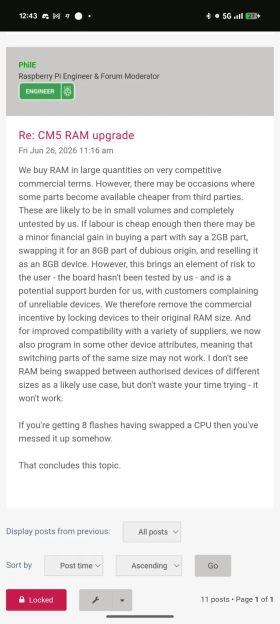 For the reference, this bootloader change happened almost exactly two years ago, at some point between September 10 and September 23, 2024. This was exactly a year and a half after we covered the first Raspberry Pi RAM upgrade. What changed?
The Raspberry Pi Foundation (RPF) justifies this as follows: they saw third-party resellers sourcing low-RAM Compute Modules, upgrading them with RAM from unknown source and unknown stability. My observation is that they’d also be reselling the modules at a markup for purely commercial gain, while undercutting RPF who would otherwise direct that money into RnD, something I much enjoy to see them do. This creates perverse incentives and risk for people buying Raspberry Pi boards online, and RPF decided to limit this primarily for their users’ benefit, plus, if you ask me, some of theirs.
Is this justification true? I can’t know, but I went to check for signs of this happening, and the non-consensual RAM switcheroos seems to be happening all over the place! The related GitHub issues have a fair few pingbacks, and exploring them makes the problem look grim to me.
Off the cuff, I spent 15-20 minutes checking, and I can easily find fifteen different people on GitHub alone complaining about this failure. [(1) (2) (3) (4) (5) (6) (7) (8) (9) (10) (11) (12) (13) (14) (15)] As far as failure modes in popular hardware go, this is a surprisingly large number that suggests at least hundreds of hackers and hobbyists affected, if not more. None of them appear to have performed the upgrade themselves, hot air and flux way, the Hackaday way – all of them seemingly simply bought a “8 GB” version from either Aliexpress or Amazon. In at least one case, the seller immediately lied to the buyer about the issue and did not at all admit that an upgrade took place, even though it clearly did.
How It Makes Sense
This seems to map exactly to what RPF says happened. I can very much see why they would be worried. For instance – at the time they made this change, if my memory isn’t failing me, CM5 or CM4 2 GB boards went for $30-$40, 8 GB boards went for $100ish, and 4 GB boards were somewhere inbetween. As far as the intersection of hacker gadgets and industrial-lite hardware goes, that price is more than fair.
At this point, we’re no longer talking about people upgrading RAM on their boards for fun, and remember, you can still do all of that. Instead, that’s a fair bit of margin for someone to grab for 20 minutes of hot air work, someone who hasn’t done any of the RnD that RPF has put in. I personally much rather would see that margin go to RPF, and I’d like to have them deal with none of the headache, too.
Creating incentives for this kind of switcheroo business, unimpeded, seems deeply corrosive to me. For one, there’s zero repercussions for someone equipping those boards with substandard and harvested chips. RPF, as any experienced hardware company, would know about sourcing harvested or otherwise shady-origin RAM and other chips. A third party on Amazon/Aliexpress passing on those chips undisclosed to unqualified end users, now that goes far beyond the usual harvested chip horror stories. It turns into a game of “will/won’t the user notice the weirdness and ask the seller for a refund on time”, and at $100-$200, together with the ship-item-back requirement these prices bring, the answer will generally be “no”. Now, the buyer finds out about the tampering almost immediately, since Raspberry Pi boards auto-update the firmware.
If you don’t agree that this alone is corrosive – notice how this kind of “upgraded” board clearly requires sellers to misrepresent what they’re selling? You’re not going to find about this “upgrade” in the listing, there won’t be a “8GB reworked” label, clearly that would require lowering the price and/or cutting into the margins. Just like there’s no incentive for using a fresh RAM chip instead of a harvested one, there’s also zero incentive to be open about the mod. That’s no way to sell a pen, much less a full computer.
How RPF Does Things
Here’s the most confusing part to me. I’m seeing [Jeff] and others say that this is out of character for RPF to do. This does not seem true to me, at all? I don’t recall a time when Raspberry Pi has put effort into giving users freedom to hack on the board itself as soon as any sort of legal or competition issue arose.
Raspberry Pi puts cryptographic EEPROMs on Pi Camera boards, v2 and beyond, to thwart clone cameras that became so prolific and cheap with v1, I own at least five of those clones in different form-factors. I don’t like it, but at least the authenticity checks are disabled for Compute Module versions, as far as I remember. They still don’t sell the MLX7704 PMIC that immediately dies if you accidentally short-circuit GPIO header 5 V to 3.3 V, two male pins that are right on the side of the board and exceptionally easy to short-circuit from three sides simultaneously.
Raspberry Pi only ever publishes “reduced” schematics, ever since 2013, and they haven’t even released those for Pi 5. Neither have they published Pi 4 USB-C issue fix schematics despite having promised to do so. Half of the chips on a modern Raspberry Pi board are single-source and board-specific, the aforementioned PMIC being a fun example. Raspberry Pi boards ship closed-source software, from the bootloader to the GPU code whipping the CPU, to all the onboard wireless chips they have used so far, and this brings real issues you’ll stumble upon as you push the limits. The JTAG port has always been locked down, and even the bootloader is cryptographically signed – no patching out the RAM check code, sorry to spoil it.
I’m far from done listing ways in which Raspberry Pi prevents or works against low-level board tinkering, there’s at least five more things I could list from memory if I were bothered to check them thoroughly enough right now. Point is, if anyone came to Raspberry Pi for the low-level hackability of the hardware, there was never a shortage of reasons to look elsewhere. That was never the upside.
I don’t think low-level board hackery is what people genuinely expect from Raspberry Pi at all, even if they might say that they do – because it was never really there. You can’t genuinely expect something that was barely ever present. In contrast, there’s plenty of competition that publishes full board schematics, sometimes even gerbers, uses as much open code as possible, doesn’t sign bootloaders, and so on. Raspberry Pi is not open or hackable hardware by those metrics, and it never was. It’s not hackable hardware anywhere as much as it’s hardware made for hackers to use, and there’s clearly a big difference.
How Did We Get Here?
In practice, people clearly come to Raspberry Pi because of their community in the millions, meticulously explored and documented hardware, unmatched availability of boards and software alike, having solutions for nigh every little niggle and nitpick, RPF’s ability to experiment and release new cool hardware year after year, and even new standards they create along the way. Most of low-level problems get papered over through sheer scale – say, last year [Jonathan Clark] reverse-engineered the Raspberry Pi Zero 2 W, and then [TubeTime] reverse-engineered the Compute Module 5, how cool is that?
I could agree with [Jeff Geerling] that it could instead benefit from a “warranty bit” type of mechanism, but really, the bootloader downgrade isn’t that hard of a penalty, and “board autoupdates firmware, fails on next boot” is a much stronger indicator that you should go get a refund at haste. A refund is also way easier to get if you say “hey, the board stopped working immediately”, and who knows, maybe you’ll get a refund and get to keep the board so that you can downgrade its firmware and still use it! Win-win, seller loses out on selling you a shady board, and you get a shady board that might just work, for free. Chances are, we wouldn’t even be talking about the RAM swap restrictions if it weren’t for the RAM shortage, and that is not RPF’s fault at all whatsoever.
My advice: don’t lament Raspberry Pi RAM upgrades, especially given they’re only slightly harder to perform now. Very few hackers ever performed them, the main audience for them turned out to be dodgy hardware resellers online, and in most cases, repair doesn’t seem to be impeded at all, either.
Think of the users that will no longer be fooled by a shady seller on Amazon, especially now that the perverse incentives for board mods and reusing harvested RAM chips are at their highest. RAM shortages might make any RAM topic hurt deeper than usual, which to me is the most likely reason we’re discussing this in 2026 instead of 2025, but this change is far more likely to help a hacker in practice, than it is to hurt.












>locked down hardware will help hackers
sir this is a wendys
The target audience of Raspberry Pi boards are infinitely more likely to be helped by this restriction than they are to be hurt by it, as I describe in the article. Especially in 2026 – the calculation has changed so much that at this point I’d straight up expect those RAM chips to be harvested from water damaged phones. If I ever feel like upgrading (not even repairing!) RAM myself, I’ll simply downgrade the bootloader and have a functional board. Sounds like a fair tradeoff to me, in exchange for having less people deal with glitchy Raspberry Pi boards, newcomers in particular. I was a newcomer once, and this would’ve sucked to deal with.
Very much agreed.
While the video seems more geared to stir controversy ( and generate views ) .
For those that need to repair, they will use the correct parts.
The normal people that are buying a very cheaper unit from some non-official place ? Well, “caveat emptor” .
The 6 or 7 normal people with the skills to do this chip replacement ? Well, they are skilled also to reflash the bootloader.
Basically, the boards only work with certified parts. So , they work, and that is the important part. If someone wants to use whichever chip-of-the-day on a board, they can design and build their own SBC´s ( document it on a series of blog posts and send a link to HaD ) .
I think the most illuminating part about this change is that it was made exactly 2 years ago, and nobody has been affected badly enough to make a fuss about it, up until RAM became a sore point for everyone – and even then it took almost an extra year for people to notice. I think the video makes some fair points, though I vehemently disagree that Raspberry Pi ever had board hardware modifiability (or any other cool things that open-source hardware brings!) as a selling point.
Tinker toys are fine until you grow out of them. Anything that shoots the advanced user in foot is bad. Advanced users get to be advanced users by shooting themselves in the foot. They need no help to shoot themselves in the foot and preventing them from doing so interferes with learning a lesson. They also come up with things that commercial vendors never will do to limited market or cost. What if I want or need faster RAM?
This is nothing more that Raspberry Pi proteccting their profit margins on boards with more memory. Sellers who sell reworked boards that don’t work don’t last long. RP can open their own official store on Amazon if they want to protect their brand name and reap the profits of trust. Otherwise its caveat emptor
I’m an OG who has written microcode to get DRAM to work. I don’t use Raspberry hardware but you don’t advance if you are locked down and pigeon holed. If we limit people to using python and Arduinos to make lights blink all we will have is blinking lights and limited choices of dev boards.
Literally at least half of this article is written from an advanced user perspective. As much as I get you, in these accursed times, there’s no shortage of boards where you can upgrade the RAM chip if you so desire – if you are an advanced user, you know about those boards and likely own a few. Raspberry Pi was never especially open about hardware, you don’t even need to remember what an Odroid W is (rather, was) to know that. Perhaps it’s best to use different boards according to their strengths and weaknesses.
My knee-jerk reaction was to agree with Jeff Geerling. Your thoughtful and well-reasoned argument has brought me around to your way of thinking.
What the Foundation is doing still bothers me, but I guess it’s inevitable when you have unscrupulous opportunists giving your product a bad reputation.
It’s not even bad reputation that bothers me personally, funnily enough, I have my own share of criticism for RPF. It’s that unwitting newcomers are going to end up with glitchy boards that randomly lock up, reboot, corrupt in-memory data as well as storage contents, and in general pretend to be unmodified boards while being sold for the price of a modified one. Such boards are terribly painful to work with, from my experience, I have no doubt they can even put people away from the hobby, and I wouldn’t wish that on anyone.
Not to mention all the newcomers that eventually turn their hobby into a profession and accidentally rely on such a board in a place where uptime is money, or people who try to build useful infrastructure out of these, so many cases where a glitchy board will easily quadruple the already non-trivial suffering we experience when building something reliable. Seeing just how many of these “upgraded” boards got sold is lowkey heartbreaking for me, and as much as I have appreciated the RAM upgrade capability, I’d much rather have newcomers to this hobby be protected.
Ah, the classic “think of the children” argument 😂
I’m sure people who have incorporated Raspberry Pis in commercial equipment are going to love the fact they are a software update away from bricking deployed systems. I hope the remember Raspberry’s attitude when designing new hardware as well.
Ah, the Windows experience!
Saw it happen with Windows 8.1 update, which silently dropped support for AMD K9 and other early X86_64 CPUs
and bricked many Windows installs after re-boot
I wonder if those “ordinary” Raspberry users that can’t be expected to a read/understand warning about modified Pi hardware
will blame Raspbian/Raspberry Pi OS for their bricked Pi or Linux in general.
After all, it’s this very OS that enforces the firmware upgrade.
This isn’t a Wendy’s and it’s not twitter either
So what is stopping dodgy resellers from downgrading the bootrom? This is a stupid article that contradicts itself.
They already ship the bootrom downgraded, the board wouldn’t function as-shipped otherwise. Raspberry Pi OS auto-upgrades Pi4/5 bootrom unless you explicitly disable the service that does the upgrade. This means that the board will stop working after the first reboot; to fix it, you can easily flash the old bootloader back over USB and then disable the service responsible. This service is also seemingly not present on OSes like Armbian and so on.
To fix this, the dodgy sellers would need to make the SPI flash chip write-protected at the very least, which, if it uses qSPI and not regular SPI, is more complicated than a WP pin bodge. I don’t know which one they use, but come to think of it, the reverse-engineered CM5 files should help figure that out.
No no no, you get it wrong! It makes perfectly sense from the view of a big corporation.
The users are being expected to use the product the way the corporation dictates.
Users are not supposed to think different or be creative.
They shall buy a higher-end model if they need more RAM.
It’s no different with some Macintosh models, either.
If you’re a corporation, you must think very strategically and profit oriented.
For example, you have to make sure that the users are encouraged
to damage the product in a way that’s not been covered by warranty/re-funds.
So they will blame themselves and buy the product again.
The GPIO header is a good candidate here.
As a corporation you make sure that the pinout is very prone to fatal shorts.
It’s very important that no protection is built-in!
Ie, you leave out protection diodes that most RS-232 UARTs have, for example.
Second is the power supply, such as the USB power input.
You must make sure that the product only works with authorized power supplies.
Such as an original, separately sold USB power brick, for example.
It seems that a user supportive change would be to throw a warning in the event a RAM change has occured. Then the user could see they were getting a modified product immediately on first use if that wasn’t what they ordered.
To frame a “feature” like locked hardware as being a good thing on hack-a-day’s a bit odd. Any industry will gladly collude and limit choice; generally it’s to go down the road to artificial price fixing.
Warnings are super easy to ignore, and the point is to financially disincentivize this shady sales practice whenever it happens. “My board stopped working within 30 minutes, code says RAM error, you sold me faulty hardware” is thousands of times more persuasive for refund reasons than “it throws a warning but ig it works”. The RPF recommendation is straightforward – get a refund for the board. I think that’s 100% the best course of action to disincentivize this kind of switcheroo “upgrades”, and bricking the board (easily reversible!) is a great way to get there, where even the least qualified user is basically guaranteed to cooperate. I can’t in good faith consider this “locked hardware” when the practical effect is that you miss out on a few quality-of-life bootloader features, and have to remember to run a single line in the terminal to prevent auto-upgrading the bootloader. You are not prevented from actually upgrading your RAM, and users are protected, not that complicated.
Single-board computers are an open market with great diversity of CPU offerings, high variance in openness and design philosophies alike, and a fair bit of competition on price, even in the hardware hellworld of today. There’s always Radxa, Odroid, Pine64, Orange Pi, Banana Pi, LicheePi, NanoPi, MangoPi, Luckfox, Milk-V, purely off the top of my head. To me, it’s ludicrous to suggest there’s a real risk of collusion here, especially on something as obscure as hot-airing on upgraded RAM. This is not at all comparable to actual practices you could argue are anti-consumer and resemble collusion, such as mobile phones all refusing to use microSD slots in favour of add-on internal storage, one after another. Funnily enough, they can’t even properly agree on that, there’s still phones being released with microSD slots and even headphone jacks if you look.
well, first, the ugly. this article suggests that at least 15 people are suffering from aftermarket RAM upgrades, but i followed one of the links and they’re suffering from this raspi artificial limitation. they aren’t suffering from bad RAM (or if they are, they don’t know it). this raspi feature doesn’t solve the problem that Arya identified, instead it creates that problem! that’s so disingenuine as to be dishonest.
but the rest of the article turned out to be exceptionally good! considering it’s hackaday apologia for raspberry, anyways.
i cringed to read that it’s ‘no big deal’ — i don’t want to upgrade RAM either, but an open source dream board for hackers shouldn’t get in my way! but the justification was supreme: it’s no big deal because this is not an open source dream board for hackers!!!!!
please convene the hackaday writers and let them all in on this! it’s true! raspi has always been “pretty good for something so intrinsically closed” and this ram limitation is just leaning into that established tradition. if there wasn’t so much dishonest fawning over the supposed openness of these awful closed boards, i for one would have nothing to complain about. :)
I do say “fifteen different people on GitHub alone complaining about this failure”, the failure being the bootloader lock-out, hopefully that makes sense. Further thoughts: 1) the seller is taking a gamble on the RAM quality (both the chip and its reflow), some people will win this gamble, while others will lose, 2) RAM errors are hell to diagnose because there’s so many other options on a board that’s supposed to be tested and determined reliable by RPF before it’s sold, 3) the user will not even suspect that a RAM modification has occurred and won’t know where to look, 4) sellers will readily and confidently lie about this modification having been performed, as I illustrate, and 5) the incentives clearly point towards anonymous sellers being able to sell boards with faulty and substandard RAM, especially today. I don’t think it’s hard to notice that this is a shitty situation to create for newcomers to the hobby, and in many ways, Raspberry Pi is a newcomer-optimized board.
Raspberry Pi being mostly closed-off to board modifications is an established tradition, yes. I’m not joking, that is factually correct. I listed a bunch of examples of it in the article, a few more in the comments, and I’m sure other people can list more. It’s also not an open-source board, never was since its very first release. It’s a board that is friendly to running open-source software on it, as well as doing a bunch of hardware/software hackery. These boards do a lot for empowering hackers, that’s not debatable, but they don’t possess the specific subset of capabilities that open hardware (or even open schematic) boards do. I think it sucks, I clearly wish it was more than that, but at this point it’s also certainly unhealthy to expect otherwise.
It is not locked hardware. If you need to replace the chip, the other modifications needed are easy for you.
But it´s not limiting choice : you are not meant to replace the memory chip. Nowhere in the product description or otherwise is stated that the user may change the ram chips if they so desire.
As said , if you want a SBC with replaceable memory, they exist.
And I think in the other article it talks about some codes that the bootloader uses to describe that it is stopping due to incorrect ram components.
This has been in the firmware for two years already. And the world didn´t end. RPis worldwide hasn´t stopped working “en masse”. Just now a click-grabbing video appeared that makes people ( who will never replace a ram chip ) voice their opinions.
If you add sticks of RAM, is it still an SBC? Doesn’t it become multi-board at that point? :)
Welcome back Arya!! We missed you around here. No kicad reviews when they bumped versions, no schematic reviews. Such emptyness without you.
And wtf, when did they start doing secure boot!! That’s shady. Doing encrypted firmware is fine for commercial products of course, you use it to validate your not chain of your software to the product.
But this is a toy a Personal Computer if you will. How will I install my own keys? How can I (commercially or not) ensure only my software runs? The bootloader now breaks that chain of trust. Sure, you can call them for special batches, but setting keys and blowing fuses is something you do as end user. Wtf RPF.
Sadly, that basically just put them on my shitlist. How dare they take away my freedom.
For the more normal people, this also means you cannot boot anything baremetal without their bootloader.
it’s funny how things come full circle. Back in the day Apple II systems had this problem, stores would buy the cheapest model without all the RAM populated, buy the cheapest RAM possible to max it out at 48k or whatever, and then sell it for much less than whatever Apple was charging for a 48k system. Which was great, until it turns out the added RAM was sketchy and failed and then whoever bought it would blame Apple.
Sometimes when messing with the old systems you’ll find them with RAM chips with an apple logo stamped on them, I heard that was Apple’s way of marking the RAM was officially supplied by them and not some sort of third-party upgrade
This is the kind of depth in an article that brought me to hackaday in the first place , excellent work!
Wasn’t the original objective of the RPi board to provide a low cost board for education, in order to make computing accessible to more demographics?
It just happened to be a good platform for hacking on too.
Locking down the RAM doesn’t really hurt the education users, just the (advanced) hacker group.
The popularity of the RPi with hackers (and integrators) led to a wave of new single board computers that spoil us for choice. If you don’t like the RPi, leave it for the educators and buy a different board.
So, if LG started recording my kids’ conversations in their bedrooms two years ago, just because I only found out about it now makes it OK? Makes me wonder why it was kept silent until June 2026.
I think any non-commercial entity, like say us hardware hackers, would have had a reasonable expectation to replace any component on a Pi (with exception of the SoC), simply because Raspberry marketed it as an open platform, and there was no IP to protect on the memory interface. As to the memory timing excuse, DDR needs to be regularly re-timed as the memory chips age. Locking down the timing makes the board fail, with perfectly usable DDR on board.
Who is most likely to “abuse” the RAM upgrade mechanism?…I am old enough to make that decision for myself. What happened to democracy?…or is this a case of “the rules are for thee, but not for me”?.
Nothing is avoiding your RAM upgrades. You want to install RAM chips from List (A) ? Use this firmware. Want to use chips on List (B) ? Use that other firmware.
The solution is akin to the Windows 11 hardware situation, which upset a lot of people.
Here, you could either argue that no one is forced to upgrade existing hardware and simply stay with Windows 10.
On other hand, some people may point out that Windows users are indirectly being forced to upgrade to latest Windows, because society moves on and new software requires Windows 11.
Either way, it’s none of the manufacturers’ business from the manufacturers’ side.
Both Microsoft and the PC makers hash their hands in inoccence.
This doesn’t change the fact that users face trouble.
In case of the Raspberry Pis, it means that Raspbian/Raspberry Pi OS gets fatter with each release.
Eventually, both a RAM upgrade and a firmware upgrade will be needed to run a current OS release in a reasonable way.
And here, again, to the the manufacturer it’s a non-issue.
The manufacturer does merely have to care about fresh users who buy the current hardware that’s still on sale.
Old users generate no money anymore, after all.
By the principles of capitalism, they’re a burden, something that costs resources to be supported.
So it’s just consequent to make sure no one does profit by using or selling obsolete hardware anymore.
Pushing competitors out of business is part of the concept, thus.
It’s considered a good manner, even. Because profits and expansion is what it’s all about.
Not to worry too much. RPF will soon price themselves out of the market anyway. There are much better alternates than RPF, like http://www.friendlyelec.com.
1st of all: Great article.
2nd: Rockchip RK3588 FTW!
Well.. You can see it this way and that.
In an ideal world, a manufacturer would treat customers with respect and trust.
It would openly communicate what the situation is with liability and warranty.
It would perceive the customer as mature and support him, try to live up to the customer’s trust.
It would communicate the restrictions openly and, if the customer wishes, try to help remedy them.
Of course, these virtues are in conflict with profit maximization, mass production
and modern predatory capitalism and its incessant downward spiral.
I think they treat their customers with respect and trust. It’s above and beyond to expect them to support de-soldering stuff and installing different chips, and they do… with a different firmware.
Try being their staff with such a broad scope. It’s not easy. They seem to do pretty well, certainly better than, say, Hewlett-Packard or something. It’s not some dark, ominous effect of “late-stage crapitalism.” People just have limitations.
Do you remember when FTDI used a windows driver update to brick devices with counterfeit chips? Lots of devices all over the world stopped working over night. Who suffered? End users and companies that thought they were using legit chips in their products. Even Microsoft was laid the law down on FTDI and made them revert the driver. Businesses also started designing out FTDI’s chips because of this stunt. RPF’s behavior parallels this and I hope that businesses that incorporate their products in their own do the same and design out their boards.