
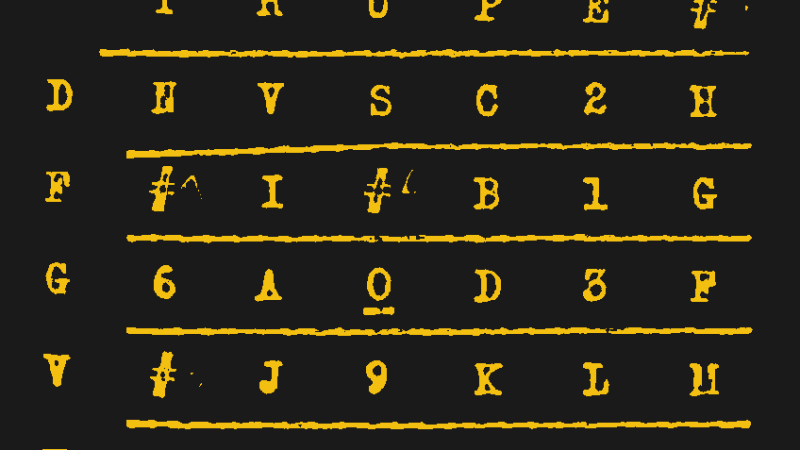
When you think of wartime cryptography, you probably think of World War II and Enigma, although there were other famous codes used during that war. But in fact, there have been codes used through wars and in peacetime for much longer. Even the Romans used codes. Of course, World War I, or The Great War, as it would have been known, had its share of codes and, as you might expect, most of these have been broken long ago. Most of them. But apparently an AI model, GPT-6 Astra, recently cracked one that was previously undeciphered.
If you aren’t up on century-old cryptography, the ADFGVX cipher appeared in 1918. It began as ADFGX, but after a few months grew an extra letter — and a larger grid. The letters were chosen because their Morse-code patterns were relatively easy to distinguish: A, D, F, G, V, and X.
The original ADFGX version used a 5×5 grid containing the alphabet, usually merging I and J. The later ADFGVX version expanded this to 6×6, making room for all the letters and the digits as well.
Encoding required a 5×5 (or 6×6) grid with the alphabet within. The table’s rows and columns were labeled… you guessed it… ADFGX pr ADFGVX. Each plaintext letter gets replaced by the corresponding row and column such as AF or XG. Finally, the letter pairs would be written under a transposition key.
Concatenating those pairs gives AGXGDDDXXF. Written in five columns under CANDY, the first row is AGXGD and the second is DDXXF.
Next, you sort the letters in the transposition key, taking the columns along with the letters. That would make the transposition key ACDNY, and the first row would now be GAGXD. Then the message is sent by columns. Too much to wrap your head around? Visit dCode and plug in some plain text, squares, and keywords for yourself.
The French broke the code in 1918, but without computers it was tough work. Codebreaker [Georges Painvin] reportedly worked on the cipher until it made him ill, but he did solve it. However, some of the intercepted messages remained a mystery. One in particular was sent on November 27, 1918. Apparently, the message used the codeword TRUPPENVERSCHIEBUNG, a German key believed to have gone into service in December. If this decoding is correct, then this message used it even earlier.
The message was, of course, in German and appears to be a report about a British ship’s movements near Sevastopol. In fact, HMS Canterbury’s position on the dates mentioned matches the message.
Honestly, we were more impressed that people like [Georges Painvin] in 1918 were able to decode these intercepted messages. But it is still an interesting glimpse into the capabilities of Astra.
It seems that as long as there has been writing, there have been ways to send secret messages. The Swiss in The Great War had their own encryption method.












Great War: change “would have bern known” to
“was known.”
In the UK at least, the term The Great War still means World War I, so I take issue with the past tense here, regardless how it is written.
This is a lot more edifying than the “AI Cracked the Voynich” headlines we’ve been getting since 2018. Recurring stories claim a chatbot or mysterious neural network decoded the manuscript. A model can always output something, but nothing repeatable, coherent, and checkable against unseen pages has ever appeared. Pattern-matching is not reading.
After much painstaking work, the message read:
” Send more toilet paper”
slow clap Truly an amazing use of a technology that made has made ram, storage and graphic cards prices skyrocket.
In recent years gaming industry went full retard with Unreal Engine and remakes of remasters. It really feels like it’s stagnant.
If people are finally outpriced from buying consoles and PCs with powerful GPUs maybe it’s for the better.
I still do not understand why we cannot simply build more chips. I’ve heard explanations but it seems like they are signs of decline, and in previous eras we would have simply expanded production, but now we can’t for mysterious and/or sad reasons
It probably takes about 3-5 years to bring totally new high end capacity online. At an extraordinary cost (approximately $28 billion for a new 2nm process node, and maybe $12 billion for a 10nm process node), people do not want to make new capacity that may not be used, due to a bubble bursting. If new capacity is brought online, and the bubble bursts before it has paid for itself with a healthy profit margin, this will flood global supply driving down profits to a pittance.
I guess you could call it capatilasm at work. No one wants to invest heavily today if profits are not guaranteed tomorrow. Think about the “Project Management Triangle” quality, cost and time. Choose to optimize two and the third one will balloon. You want it quick and high quality, so the cost will go through the roof. If you want to optimize for maximum quality and minimum cost then the time required will go through the roof.
“World War I Coded Message Appears Cracked, Finally”
I’m somehow amazed that it took so long for the message to be decoded.
You might expect that either the person who send it or the person who it was send to would be able to decode it. I think I’m missing something?!?