
Nuclear power really hit its stride in the 1950s. In the post-war period, there was a rush to develop peaceful uses for splitting the atom, beyond its application as a weapon of war. Soon enough, nuclear reactors were hooking up to power grids and helping propel ships and submarines around the globe.
Eventually, this led to an obvious idea—what if a ship with a reactor could serve as a floating nuclear power station? That question would be answered in the mid-1960s, with an American project of some strategic importance.
Whatever Floats Your Boat
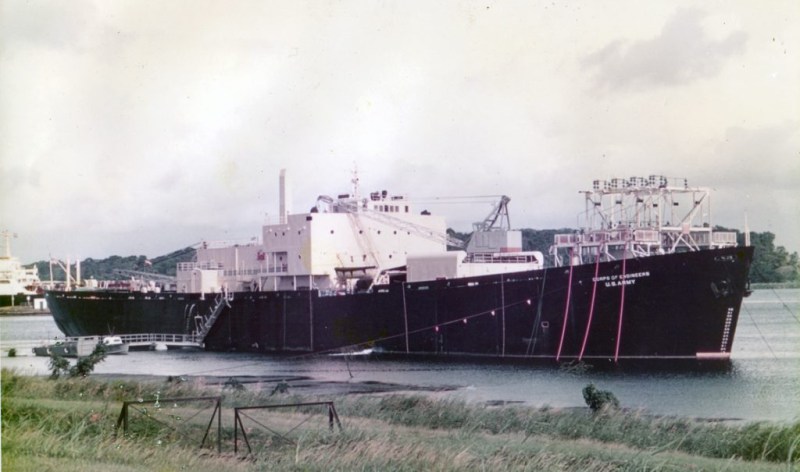
You might think that the first floating nuclear power plant would have been a US or Soviet navy project, but you’d be quite wrong. Instead, it was actually the US Army which was responsible for achieving this feat. The project began as part of the US Army Nuclear Power Program, which was intended to develop small reactors that could be deployed to remote regions to supply electricity. One of the results of that program was MH-1A, the nuclear reactor abord the vessel otherwise known as the USS Sturgis.
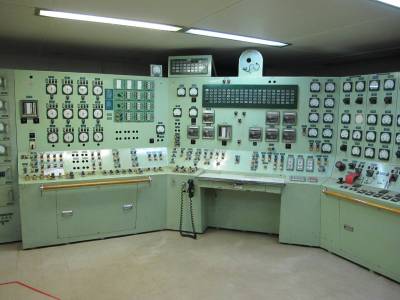
The contract for the Sturgis’ reactor was awarded to Martin Marietta in 1961. Termed the MH-1A, standing for Mobile, High Power, the reactor was a pressurized water unit running on low-enriched uranium, built inside a 350-ton containment vessel. Nameplate capacity was a healthy 10 megawatts. The ship itself was not a clean-sheet design; instead, it was built out of a converted Liberty Ship left over from World War II. The former cargo vessel was formerly known as the SS Charles H. Cugle. As part of its conversion, it had its propulsion system removed, since it was intended to operate from fixed moorings or anchorage for extended periods of time. It was deemed uneconomical to otherwise maintain the capacity for independent propulsion.
The MH-1A reactor was installed in the Sturgis while it was moored at Gunston Cove, near the Fort Belvoir facility that hosted the Army’s very first nuclear reactor, the SM-1. The reactor first went critical in January 1967, and was accepted into Army service six months later in July. The Sturgis would remain at Gunston Cove for the following 11 months, where it supplied electricity to Fort Belvoir in lieu of any required operational use.
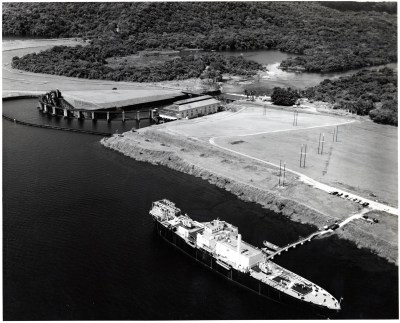
The Sturgis did not have to wait long to be called into service. It was initially considered for deployment in the Vietnam theatre, but instead, it would wind up serving in Central America—but not for entirely unrelated reasons. In 1968, the Panama Canal was
facing somewhat of a crisis. The dry season led to water shortages, with authorities forced to ration what was ran through the Gatun Hydroelectric Station for local energy needs, and what was used to run the locks to allow ships to transit the Panama Canal. To aid in keeping the canal open, the US Army deployed both the Sturgis, as well as the Andrew J. Weber, a diesel-powered power barge of some 20 MW capacity. The two ships were hooked up to support the power needs of the Canal Zone, in turn freeing up water resources for the locks of the Panama Canal. This allowed the passage of an additional 15 ships through the canal per day. The deployment wasn’t entirely altruistic, of course. Keeping traffic flowing through the canal was undoubtedly an aid to US logistics during the Vietnam War, with much materiel passing through this route during the conflict. The Sturgis ultimately stayed on station until 1975, eventually being replaced by Hitachi turbine generators instead.
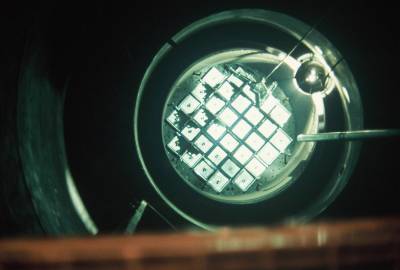
Beyond its trip to Panama, the Sturgis didn’t have much else to do. It was retired from service in 1976, since the Army Reactor Program had been ended and its generation capacity had been replaced with more practical solutions at the canal. It returned to the US in 1977, where its fuel was removed at Fort Belvoir. It was then moored as part of the James River Reserve Fleet for long-term storage. Eventually, a $35 million contract was awarded in 2014 to decommission and dispose of the reactor, with the rest of the ship then to be scrapped as per usual shipbreaking practices. The process was completed by 2019, and the world’s first floating nuclear power station was no more.
The story of the Sturgis is rather a strange one. Military planners conceived that a floating nuclear power plant could be incredibly useful, and not long after it was completed, they found the perfect application for it. Once that application was no longer important, the ship was mothballed in short order.
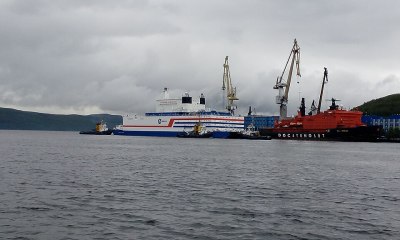
Since then, the world hasn’t seen a whole lot of floating nuclear power stations. Russian efforts netted a single nuclear-powered barge in 2019, but plans to produce more have not yet come to fruition. Ultimately, it seems hard enough for our modern civilization to put together new reactors for use on land, let alone portable floating units that can be deployed at will. It seems like there just isn’t quite enough demand to justify their existence in greater numbers than one at a time.
Featured image: “MH-1A, STURGIS Nuclear Barge”, US Army Corps of Engineers












In case of Russia they have a hard time maintaining their only aircraft carrier. Until they bring it back to service, why would they waste money and resources on some Scooby-Doo floating reactors thing that won’t see much use?
There are a lot of remote towns, military and mining sites in Russia’s Arctic north that are not connected to their electrical grid. A power plant on a barge, that can be towed into place during summer when the waters are ice-free, has many potential uses.
This was the original proposed use for the small modular reactors for the US and Canada. Especially in Canada where mining sites are isolated and running high tension is near impossible and fueling is too expensive. The transport for the SMR was projected to be by semi truck or train which limited the size to “conex box” size
Oh, Liberty Ships had the tendency to break apart due to bad steel and missing expertise in welding int the early days… They lost more that 100 of the 2700 boats to that.
Welded hulls did worse than rivets
“It seems like there just isn’t quite enough demand to justify their existence in greater numbers than one at a time.”
Natural (or not so) disasters may change that equation.
Right, don’t want a potential nuclear disaster in such an area.
The Gerald Ford is being moored in a mobile electric generator role exactly the same as the Sturgiss to test its utility in disaster recovery scenarios.
So remind me what neutrons do to Iron found in ships and submarines over a period of years.
Hints:
Trace amounts of natural Cobalt-59 is found in all steel capture a neutron to become Cobolt-60. Cobolt-60 has been used to mutate DNA in plants
Oh and Iron-55 releases X-rays as its decay chain.
And there is also Iron-59 which emits gamma rays (and beta particles).
And let’s ignore microscopic rust particles which can enter the water supply or ventilation.
There is a reason they are scrapped.
How exactly are these neutrons getting to the ship’s steel?
Magic ✨
(This is what happens when morons with radiophobia are allowed free speech without adequate education 🤦♂️)
Electric eels mutate fish DNA too
Modern reactors use lots of water and ridiculous amounts of plastic to help capture neutrons, but not the old reactors. And that is the case here. The ratio of the diameter of a hydrogen atom to the diameter of a neutron is approximately 100,000 to 1. That is a lot of space for a neutron to sail right through atoms without even the potential of being captured.
“Plastic”? I thought it was graphite, or graphite-ceramic or something?
The reason is, that steel has a natural decay, causing weak radiation which is too much in high-sensitivity applications. While the half-life period in 2000+ years old steel is over.
I’m also not a fan of nuclear power, but please stop with that story piece.
Where there nuclear submarines that constitute “peaceful uses”?
I guess using thorium-reactors would’ve been more in line with “peaceful usage”?
My personal favorite was the NB-36H, a B-36 “Peacemaker” nuclear bomber that was modified to carry a functioning nuclear reactor. Massive amounts of lead shielding protected the crew. This beast was flown on dozens of test flights during the mid-1950’s.